Embroidery guide
Single vs Multi Needle Embroidery Machine: Which Do You Need?
Single vs multi needle embroidery machine: how each works, the real time cost of color changes, caps, hoops, file formats and which one suits your work.
Quick answer:
- A single-needle machine holds one thread. It stops at every color change and you re-thread it. It suits gifts, home decor and one-off projects.
- A multi needle embroidery machine holds 6 to 15 threads, changes color on its own, and hoops garments around a tubular arm. It costs several times as much and needs more space.
- Both sew one stitch at a time. The multi-needle saves time on color changes and hooping, so it pays off when you sew the same design on many items.
- Start single-needle unless you already have regular orders, structured caps or lots of multi-color work.
The choice between a single-needle and a multi needle embroidery machine is mostly about how you work, not stitch quality. Both can sew a clean design from the same file. What differs is how often the machine waits for you, how a garment is held, and whether caps and finished bags are practical.
Below: how each type works, the real time cost of thread changes in a worked example, then caps, hoops, file formats and buying used. No model picks or prices; those change too often.
Single needle vs multi needle embroidery machine at a glance
| Single-needle | Multi-needle | |
|---|---|---|
| Needles | 1 | Commonly 6 to 15, each pre-threaded |
| Color change | Machine stops; you cut, re-thread and restart | Automatic: the next needle moves into place |
| How the hoop is held | Flat on the machine bed | On a moving frame around a tubular arm (most models) |
| Caps | Soft caps flat-hooped; structured caps are hard | Cap frame on a cap driver |
| Finished bags, sleeves | Awkward or impossible | Often possible, if the item fits around the arm |
| Typical file format | The brand's own (PES, JEF, VP3, EXP) | DST, plus the brand's own on many home-brand models |
| Space and noise | Fits on a desk; fairly quiet | Needs a sturdy dedicated table; louder |
| Cost | The entry point | Usually several times the price of a single-needle |
How a single needle embroidery machine works
A single needle embroidery machine has one needle, one spool of thread and an embroidery unit: the motorized arm that moves the hoop. Some are embroidery-only; combination machines also sew.
You hoop the fabric with stabilizer (the backing you hoop under the fabric) and clip the hoop to the embroidery unit, where it lies flat on the bed. At the end of each color the machine stops and shows the next one. You cut the old thread, thread the new color, press start and trim the tail.
For one item at a time, that rhythm is fine. Our machine embroidery for beginners guide covers a first project on this kind of machine.
How a multi needle embroidery machine works
A multi needle embroidery machine has a needle case: a row of needles, commonly 6 to 15, each fed from its own cone on a stand above the head. You thread every needle once.
At a color change, the machine trims, slides the needle case so the next needle sits over the hoop, and carries on. If a thread breaks, most multi-needle machines detect it and stop.
Two points are easy to get wrong:
- It still sews with one needle at a time. Ten needles don't mean ten times the speed. The gain is that stops between colors take seconds instead of minutes.
- You tell the machine which needle has which color. On the screen you assign each color stop to a needle number. If needle 3 holds red and the first color is red, the first stop goes to needle 3. Get it wrong and the design sews in the wrong colors.
"Commercial embroidery machine" usually means this kind of machine: a multi-needle head built for long runs. Higher-volume shops use multi-head machines, several heads on one frame sewing the same design on several garments at once.
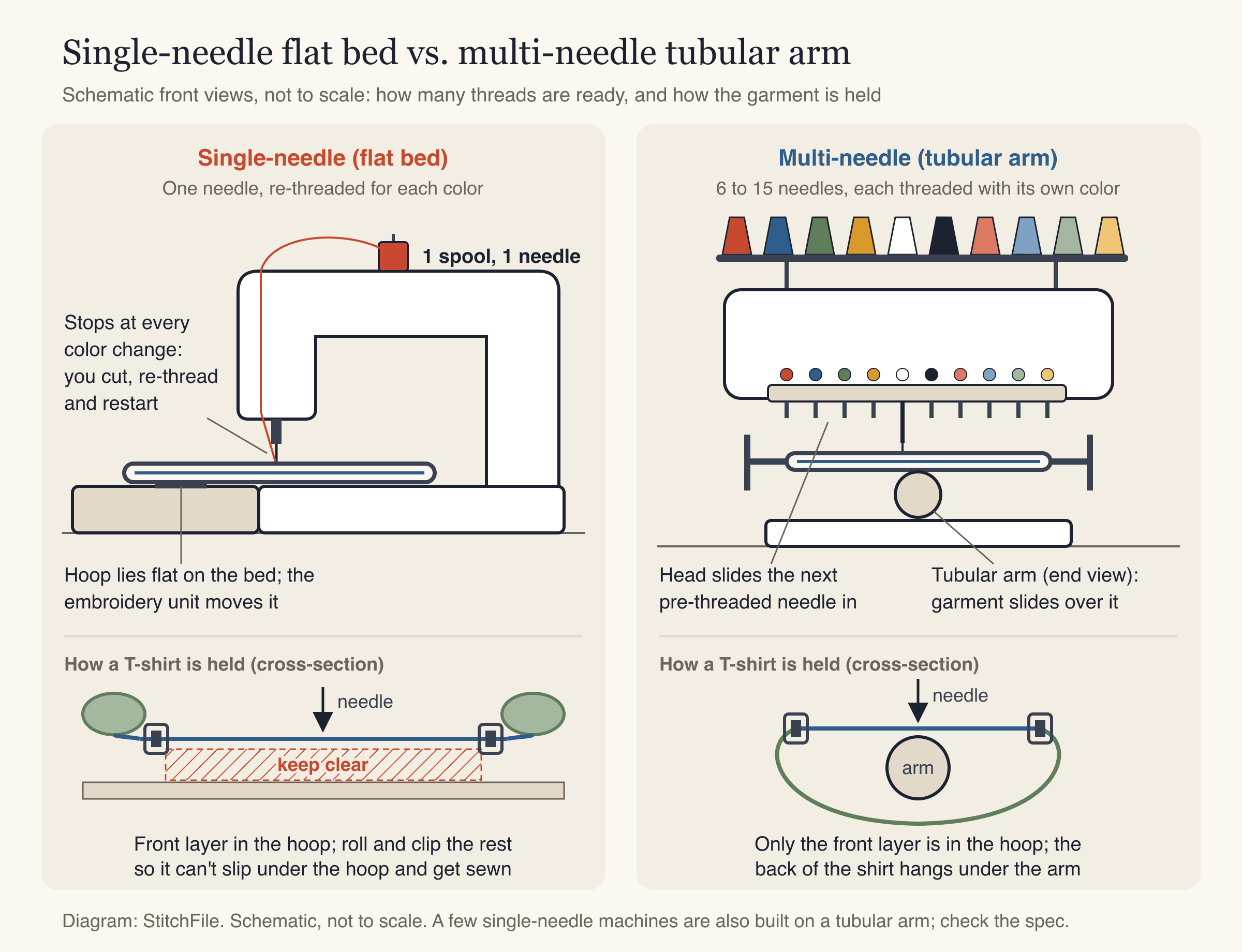
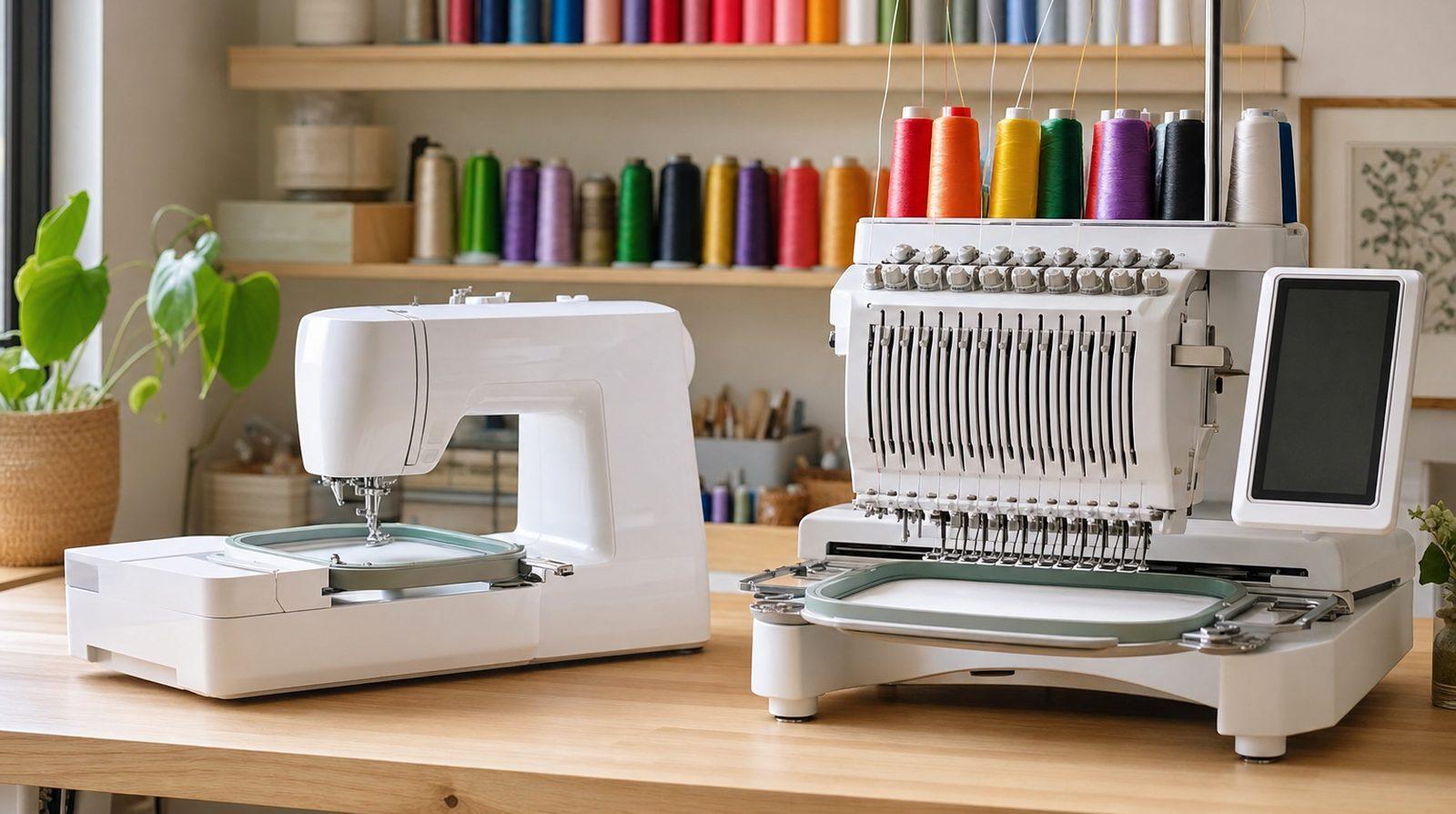
Left: one needle, the hoop flat on the bed, the rest of the garment rolled away. Right: a needle for every color, and the shirt slid over the tubular arm so only the front layer is hooped.
Flat bed vs tubular arm
This matters as much as the needle count.
Flat bed. On a single-needle machine the hoop sits flat on the bed. For a T-shirt, only the front goes in the hoop, and the back has to be rolled and clipped so it can't slide under the hoop and get sewn to the front. It works, but it takes care every time, and closed, narrow items like sleeves or a finished tote bag are hard to get around the hoop.
Tubular arm. Most multi-needle machines have a tubular arm (also called a free arm or cylinder arm). The garment slides over it like a sleeve over your arm; the hoop holds the front layer and the back hangs underneath, out of the way. That makes T-shirts, hoodies and polos quicker to hoop, and finished bags, sleeves and pant legs possible when they fit around the arm.
Flat items like towels and patches hoop easily on either machine. A few single-needle machines also have a tubular arm, so read the spec.
Hoop and field sizes
The embroidery field is the area the needle can reach in one hooping. Home machines are usually sold by their largest field.
| Hoop | Field (mm) | Common on |
|---|---|---|
| 4×4 in | 100 × 100 | Entry single-needle machines; small designs on any machine |
| 5×7 in | 130 × 180 | Many home machines |
| 6×10 in | 160 × 260 | Larger home machines |
| 8×8 in | 200 × 200 | Larger home machines |
| 8×12 in | 200 × 300 | Large home machines and many multi-needle machines |
Multi-needle machines usually come with tubular hoops in several sizes, from small sleeve hoops to large frames for jacket backs. Maximum fields vary by model, and hoops fit one brand, often one model. Our embroidery hoop sizes guide has to-scale charts.
Speed: what stitches per minute means
Machines are rated by top speed in stitches per minute (spm). As a typical range, single-needle home machines top out around 400 to 1,000 spm, and multi-needle machines are commonly rated around 1,000 to 1,200 spm, some commercial heads higher.
You rarely sew at top speed. Caps, metallic thread, dense fills and small lettering usually go slower. A common planning figure is 700 spm, which StitchFile uses for its sew-time estimates. At that speed a 10,000-stitch design takes about 14 minutes of stitching on either machine.
While stitching, the machines aren't far apart. The gap is in the stops.
The real time cost of thread changes: a worked example
Here's a real design. We ran a tiger face through StitchFile at the 4×4 hoop preset (95 mm) with the Woven fabric preset. The report gives the numbers we need: stitch count, colors in sewing order, trims, the smallest hoop and an estimated sew time.
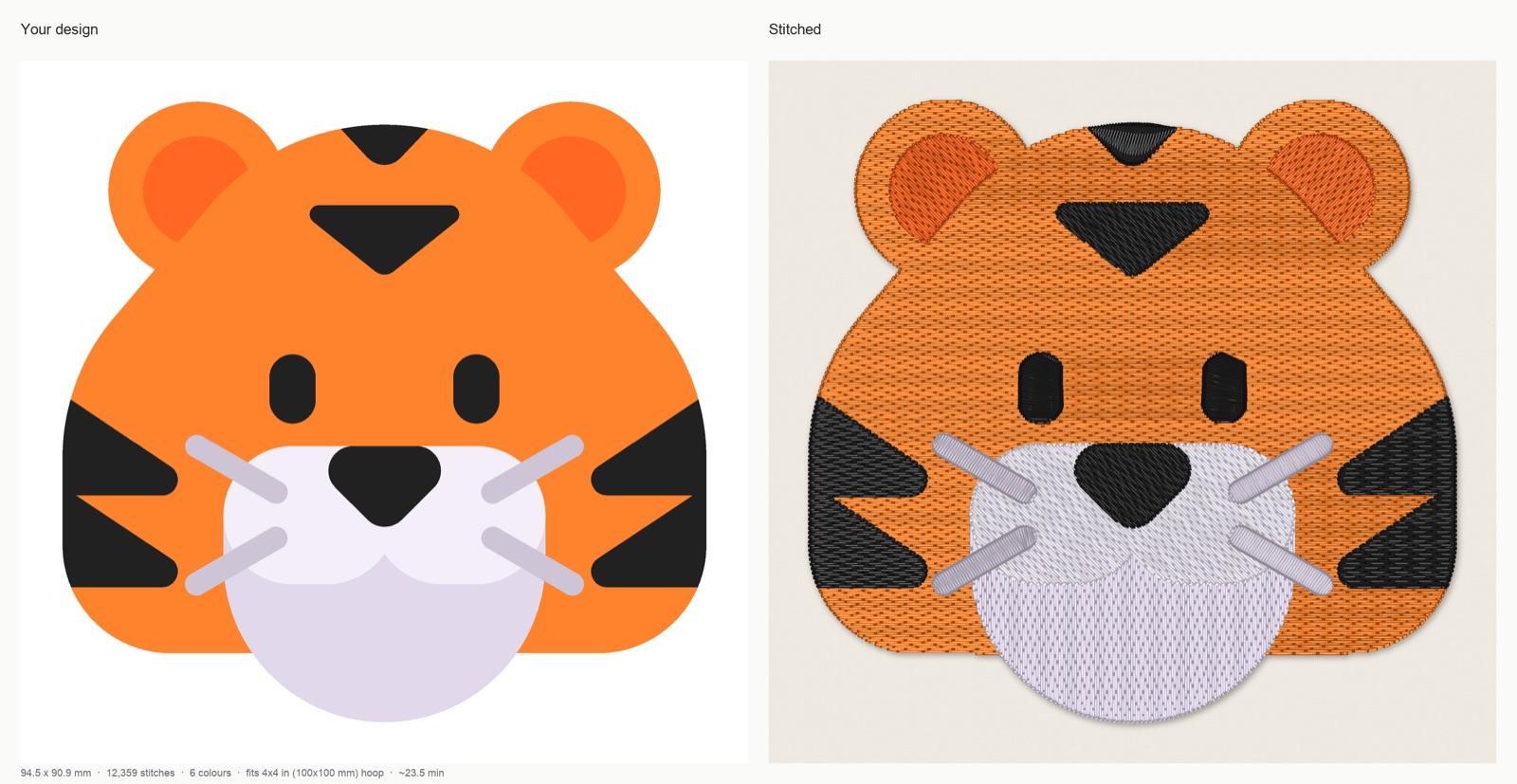
StitchFile stitch preview at the 4×4 hoop preset on woven fabric: 94.5 × 90.9 mm, 12,359 stitches, 6 colors, 33 trims, fits a 4×4 in (100 × 100 mm) hoop, about 23.5 minutes at 700 stitches per minute.
Tiger artwork: Microsoft Fluent Emoji, copyright (c) Microsoft Corporation, MIT License. Stitch preview generated by StitchFile from the artwork.
Six colors means five color changes. Stitch and trim counts come from the report; the change times are assumptions for the example.
- Stitching: 12,359 stitches ÷ 700 spm = 17.7 minutes on both machines.
- Trims: 33 trims at about 6 seconds = 3.3 minutes, assuming both machines trim automatically. If yours doesn't, add time for cutting jump threads by hand.
- Color changes, single-needle: 5 at 1 minute each (stop, cut, re-thread, restart, trim the tail) = 5 minutes. Experienced hands are quicker; beginners are often slower.
- Color changes, multi-needle: 5 at about 10 seconds = under 1 minute.
- Total per piece: single-needle 26.0 minutes, multi-needle 21.8 minutes.
StitchFile's 23.5-minute estimate sits between the two because it includes a smaller allowance for trims and stops.
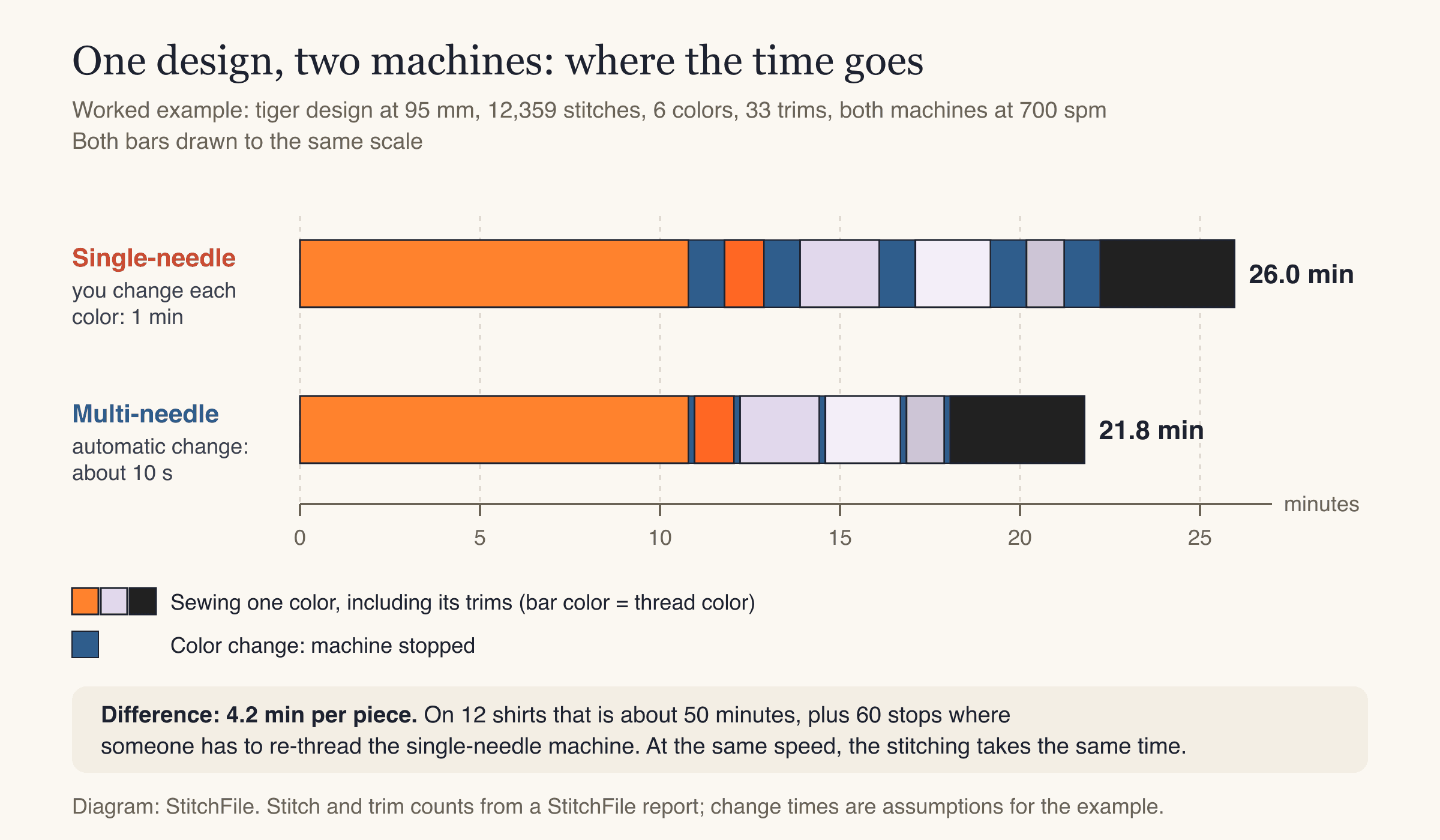
The same design on both machines, drawn to scale. The colored blocks match; only the blue stops differ.
Four minutes per piece grows with every item, and the single-needle needs you there for each stop. Here's a batch of 12 shirts, assuming 2 minutes to hoop each. On the multi-needle you hoop the next shirt in a second hoop while one sews, so only the first hooping holds the machine up.
| 12 shirts, same design | Single-needle | Multi-needle |
|---|---|---|
| Stitching and trims | 251 min | 251 min |
| Color changes (60 in total) | 60 min | 10 min |
| Hooping while the machine waits | 24 min | 2 min |
| Total machine time | about 5 h 36 min | about 4 h 24 min |
| Times you must step in | 60 re-threads + 12 hoopings | 12 hoop swaps |
That's about 1 hour 12 minutes saved on one small order, before counting that multi-needle machines often run faster than 700 spm on flat garments. For one-off gifts it hardly matters.
Cut the stops on any machine
Fewer colors means fewer stops. StitchFile's Fewer colours edit is a slider that merges look-alike colors first. Here, merging the two oranges would save one stop per piece and 12 on the batch: 12 minutes on a single-needle at our 1-minute assumption. Every download includes a thread color key in sewing order for laying out threads or assigning needles. Our guide to embroidery stitch count explains how stitches turn into sew time.
Caps
Caps are a common reason to move to a multi-needle machine.
- Soft, unstructured caps can be sewn on a single-needle machine by hooping sticky stabilizer and pressing the cap front onto it.
- Structured caps (stiff buckram behind the front) sew best on a cap frame, which holds the cap in its curved shape and mounts on a cap driver that rotates it as the design sews. Cap drivers are a multi-needle feature.
Cap designs stay small, usually 50 to 60 mm wide. The method for both machines is in our guide on how to embroider a hat.
File formats: home formats vs DST
Brother and Baby Lock read PES, Janome reads JEF, Husqvarna Viking and Pfaff read VP3, Bernina and Melco read EXP, and Tajima and most commercial and multi-needle machines read DST. Multi-needle models from home-machine brands often read their brand's format as well as DST. Your manual has the full list.
DST doesn't store thread colors. It records the stitches and where each color stop falls. On a multi-needle machine that's normal, because you assign needles to stops anyway, but follow your color key rather than the colors on the screen. The file formats guide covers the details.
If you might change machines, or run both types side by side, keep designs in more than one format. Every StitchFile purchase includes PES, DST, JEF, EXP and VP3, so a design made for your home machine also runs on a multi-needle machine without another conversion. The preview shows the smallest hoop the design fits, so you can check it against either machine first.
Space, noise, cost and the learning curve
- Space. A multi-needle machine is taller and much heavier than a home machine and needs a sturdy dedicated table, with room for the hoop to move and garments to hang off the arm.
- Noise. Multi-needle machines are louder, especially at speed. Think about where it will run.
- Cost. Expect several times the price of a capable single-needle, and budget for extra hoops, a cap driver and frames if they aren't included.
- Learning curve. Tubular hooping, needle assignment, tension across many needles, cap setup and a stricter oiling routine. Allow a few weeks of practice before taking paid orders on it.
Which should you choose?
| You are... | Usually the better fit | Why |
|---|---|---|
| A hobbyist making gifts and home decor | Single-needle | One-off items; color stops cost little |
| An Etsy seller starting out | Single-needle, 5×7 in field or larger | Prove demand first; pick fewer-color designs |
| An Etsy seller with steady repeat orders | Multi-needle | Color changes and hooping become the bottleneck |
| Selling caps, especially structured ones | Multi-needle with a cap driver | Cap frames are made for this |
| A small shop doing team and company orders | Multi-needle (or several) | Batches, DST files, tubular hooping |
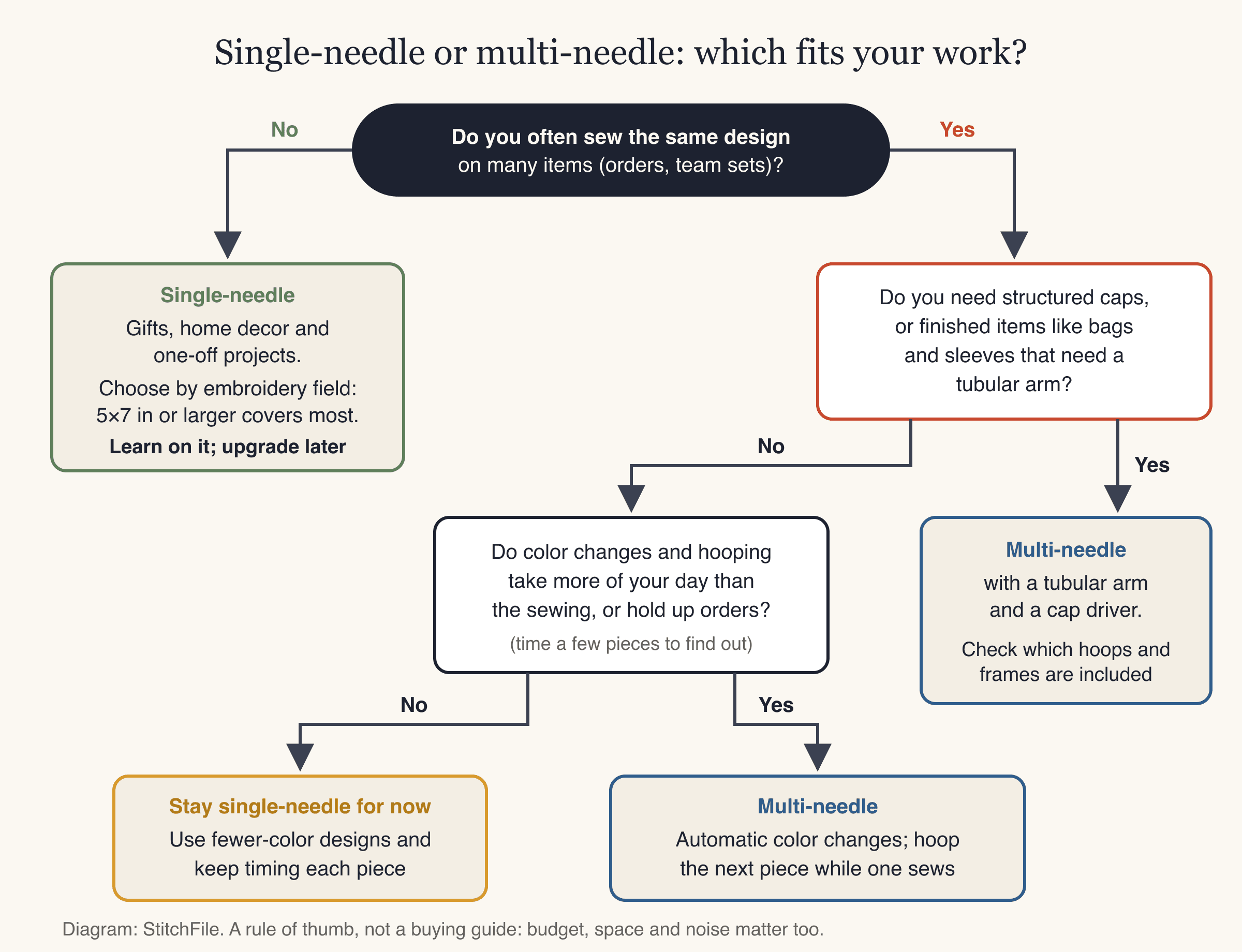
A rule of thumb: the more often you sew the same design, the more a multi-needle machine pays back.
If you sell your work, price in machine time and your own time at the machine. Our guide on how much to charge for embroidery goes through it.
Signs you've outgrown a single needle machine
- You spend more time re-threading and hooping than the machine spends stitching.
- You turn down or delay orders because the machine is busy.
- Customers ask for structured caps, finished bags or sleeves.
- You regularly sew the same design on 10 or more items.
- You avoid good designs because they have too many colors.
Buying a used multi-needle machine: what to check
Repairs are expensive, so see it sew in person if you can.
- Ask for the stitch counter reading. Many machines record total stitches sewn, which says more about wear than age does.
- Sew a test design that uses every needle. Each should sew cleanly, and every color change should be smooth.
- Check the trimmer and thread-break sensor. Break a thread on purpose; the machine should stop.
- Run it at full speed. Listen for knocking or grinding; watch for skipped stitches.
- Count what's included. Hoops, hoop arms, cap driver, cap frames and manuals must match this machine.
- Load a design from USB in the format you'll use, usually DST, and check for error messages.
- Find out about service. Is there a technician near you who works on this brand?
Common mistakes
- Expecting more needles to sew faster. Only one sews at a time; the gain is in the stops.
- Buying a multi-needle before you have the orders. Prove demand on what you have first.
- Wrong needle assignment. The right file with the wrong needle order sews the wrong colors. Check the color key before each run.
- More colors than needles. A 12-color design on a 6-needle machine still needs a manual re-thread partway. Reduce colors or plan the stop.
- Skipping the test sew. A new machine or a new format gets a test on scrap fabric with the same stabilizer first.
FAQ
Is a multi-needle embroidery machine worth it for a beginner?
Usually not as a first machine. It costs several times as much, takes more space and has a steeper learning curve, and its advantages show mainly when you sew the same design many times. Most people learn on a single-needle machine and upgrade when color changes become the bottleneck.
Does a multi-needle machine sew faster than a single-needle?
Somewhat. Multi-needle machines are often rated for higher speeds, but the bigger saving is automatic color changes and hooping the next item while one sews. In our worked example at 700 spm, one six-color design took 26.0 minutes on a single-needle and 21.8 on a multi-needle.
What is a commercial embroidery machine?
The term usually means a multi-needle machine built for long production runs, with a tubular arm, cap frames and DST files. Multi-head commercial machines have several heads on one frame and sew the same design on several garments at once.
Can a single needle embroidery machine do hats?
It can do soft, unstructured caps flat-hooped on sticky stabilizer, and some models offer a cap hoop accessory. Structured caps with stiff fronts sew best on a cap frame, which is a multi-needle feature. An embroidered patch is the reliable fallback.
What file format do multi-needle embroidery machines use?
Most multi needle embroidery machines read DST, the standard commercial format. Models from home-machine brands often also read their own format, such as PES. Your manual lists every format your machine accepts.
How many needles do I need on a multi-needle machine?
Enough to cover the colors you use most without re-threading. Six needles covers many logos, and more let you keep common colors loaded between jobs. Designs with more colors than needles still sew, with a manual re-thread partway through.
Get a design ready for either machine
Whatever you sew on, the file comes first. Upload your logo or artwork to StitchFile, choose a size and fabric, and the free preview shows the stitch count, colors, trims, sew time at 700 spm and the smallest hoop it fits. Use Fewer colours to cut thread changes, then download PES, DST, JEF, EXP and VP3 together, so the same design runs on your home machine today and a multi-needle machine later.