Embroidery guide
How Much to Charge for Embroidery: A Pricing Method That Works
How much to charge for embroidery: a step-by-step pricing method with a worked example, a per-1,000-stitch rate, quantity breaks and a copyable worksheet.
Quick answer: Work your price out from your own costs, not from someone else's listing.
- Add up the per-item cost: blank garment, consumables, machine time, hands-on labor and an overhead share.
- Add the setup cost for the order (file, proof, machine setup, test sew-out) divided by the quantity.
- Divide by (1 − your fee % − your profit %) to get the price.
- Add extras (names, rush, customer-supplied garments) and set a minimum. The worksheet below does all of it.
How much to charge for embroidery is the question every Etsy seller and home-based shop hits after the first few paid orders. The honest answer is that nobody can give you a correct number from the outside. Your blank costs, machine, speed, platform fees and the hourly rate you want to earn are different from everyone else's, and a price copied from another shop carries their costs, not yours.
So this guide doesn't quote "going rates." It gives you a method you can run on any order, a worked example with clearly labelled example numbers, a way to calculate your own per-1,000-stitch rate, a quantity-break chart and a worksheet you can copy. The only real prices here are StitchFile's own file prices, used as the file cost line.
Why "how much does embroidery cost" has no single answer
When a customer asks how much embroidery costs, the answer depends on five things that change from job to job:
- The item. A cheap tote and an expensive jacket carry very different garment costs, and very different risks if a stitch-out goes wrong.
- The design. Stitch count drives machine time. A small outline logo sews in minutes; a dense full-back design takes many times longer.
- The handling. Hooping, thread changes, trimming and pressing take about the same time whether the logo has 3,000 stitches or 8,000.
- The quantity. Setup is paid once per order, so one shirt carries all of it and 48 shirts share it.
- Where you sell. Marketplace and payment fees are a percentage of the price, and they differ by platform.
That's why published embroidery prices vary so much, and why the method matters more than any single number.
The embroidery pricing formula
Every price in this guide comes from one formula:
Price per piece = (per-item cost + setup cost ÷ quantity) ÷ (1 − fee % − profit %)
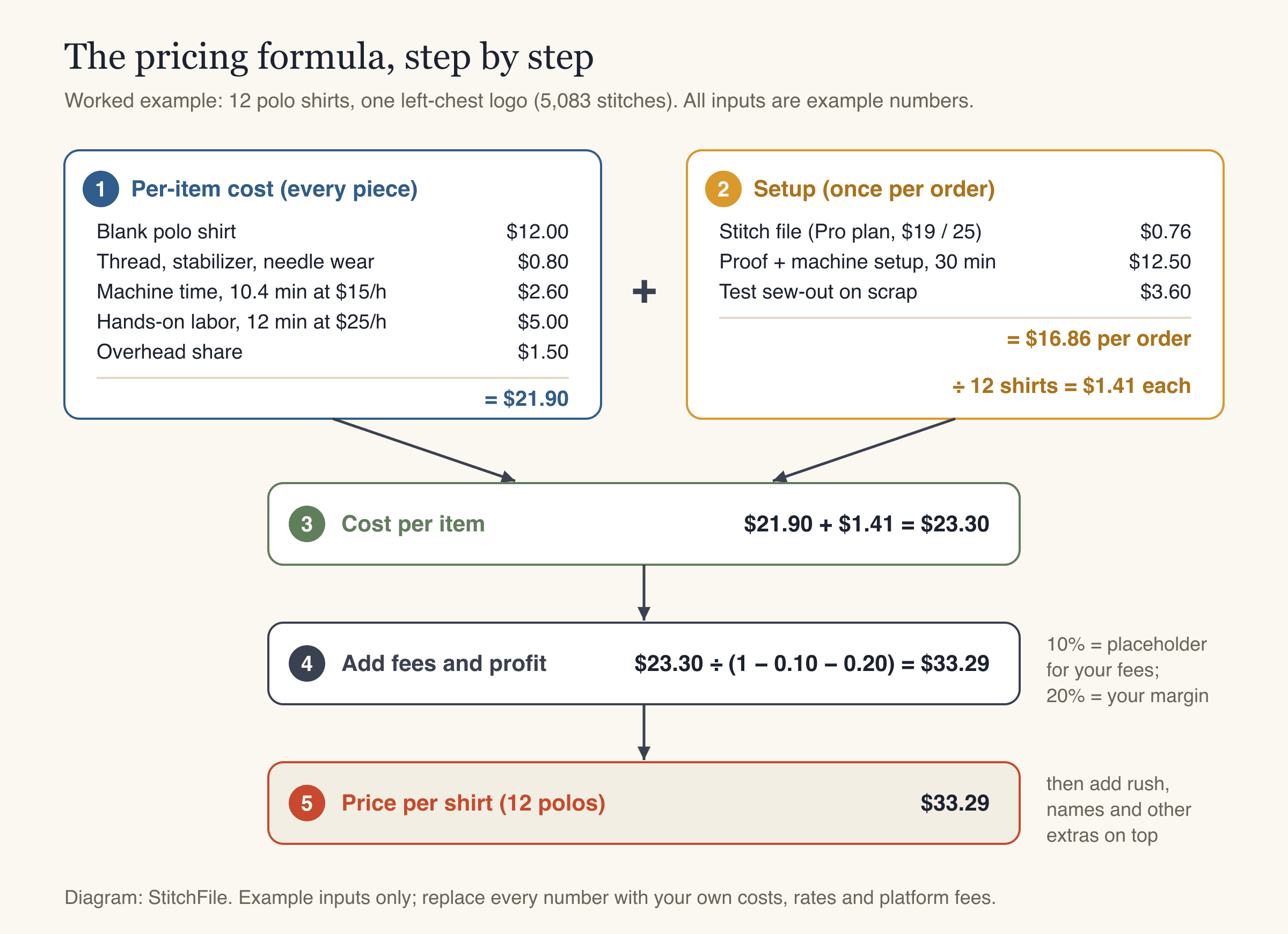
The formula applied to the worked example below: 12 polo shirts with one left-chest logo. Every input is an example number.
Dividing by (1 − fee % − profit %) instead of adding a markup matters. Fees are taken from the final price, so fees and profit have to be percentages of the price, not of your cost. The "common mistakes" section shows what the difference costs.
How to price embroidery, step by step
Work out these eight inputs once for your shop. Most stay the same from order to order; only the garment, the stitch count and the quantity change.
- Garment cost. What you pay for the blank, including your share of the supplier's shipping.
- Consumables per item. Stabilizer (and topping where needed), thread, bobbin thread and needle wear. Divide a month's consumables spend by the pieces you sewed that month. It's small, but it isn't zero.
- Machine time. Sew minutes for the design (see below) times a machine rate: what your machine costs you per hour of sewing. A simple way to set it: (machine price ÷ months you expect to use it + monthly maintenance) ÷ hours you sew a month.
- Hands-on labor. Time yourself on a real piece: hooping, thread changes, unhooping, trimming, pressing and bagging. Multiply by the hourly rate you choose to pay yourself, one you'd accept from an employer for skilled work.
- Overhead share. Monthly costs not tied to one item (subscriptions, electricity, tools, packaging, listing fees, an allowance for ruined pieces) divided by the pieces you sew in a typical month.
- Setup per order. The stitch file, proofing it with the customer, threading the machine and a test sew-out on scrap. Paid once per design per order.
- Fees. Every percentage your sales platform and payment processor take on a sale, from your platform's current fee page.
- Profit margin. The share of the price left after every cost, including your wage. Labor pays you for your time; profit pays the business for risk and slow months.
Get the stitch count and sew time before you quote
Machine time is the input most people guess. It doesn't need guessing: it comes from the stitch file. Upload the customer's SVG, PNG or JPG to StitchFile, pick the Left chest preset (90 mm) and the fabric, and the free preview shows the stitch count, thread colors, trims and sew time at 700 stitches per minute in about 20 seconds, before you buy anything. It also flags lettering that's too small for the size, which is worth knowing before you promise a customer anything. Our guide to embroidery stitch count explains what drives the number.
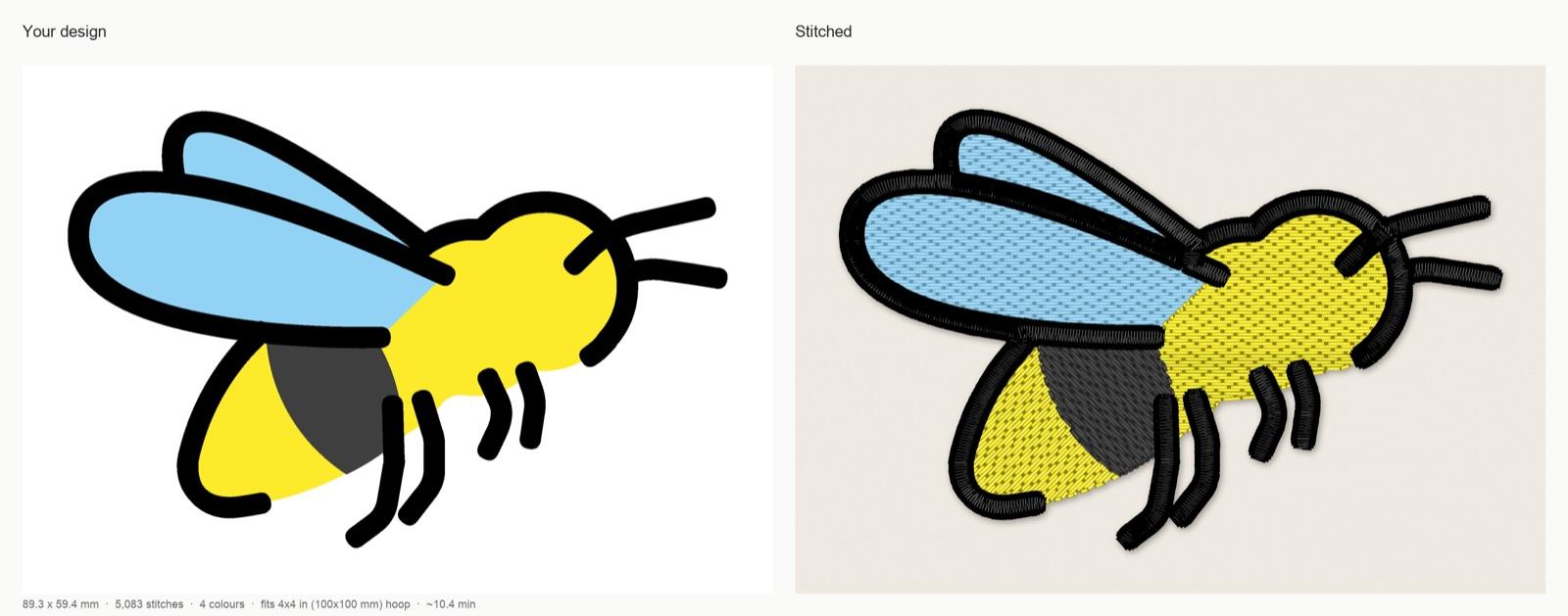
StitchFile stitch preview with the Polo piqué setting at the left chest preset: 89.3 × 59.4 mm, 5,083 stitches, 4 thread colors, 16 trims, about 10.4 minutes at 700 stitches per minute, fits a 4×4 in hoop. The color key recommends cut-away stabilizer plus water-soluble topping.
Artwork: OpenMoji honeybee, CC BY-SA 4.0. StitchFile converted the artwork into the stitch preview shown here; these adaptations are shared under the same license.
The 10.4-minute estimate adds a little time for each trim and thread change on top of 5,083 ÷ 700. Your machine may sew slower than 700 stitches per minute, and on a single-needle machine every color change waits for you. Time one real sew-out, compare it with the estimate, and use that ratio on future quotes.
How much to charge for embroidery: worked example and worksheet
A local business orders 12 polo shirts with the bee logo above on the left chest, and you supply the shirts. Every number in the "Example" column is hypothetical, chosen to show the method. Copy the table into a spreadsheet, fill in "Yours", and recheck it whenever a supplier, a fee or your hourly rate changes.
| Line | How to work it out | Example | Yours |
|---|---|---|---|
| A. Garment | Blank price + supplier shipping share | $12.00 | |
| B. Consumables | Stabilizer, topping, thread, needle wear | $0.80 | |
| C. Machine time | Sew minutes × machine rate ÷ 60 (10.4 min × $15/h) | $2.60 | |
| D. Hands-on labor | Minutes × your hourly rate ÷ 60 (12 min × $25/h) | $5.00 | |
| E. Overhead | Monthly overhead ÷ pieces a month ($150 ÷ 100) | $1.50 | |
| F. Per-item cost | A + B + C + D + E | $21.90 | |
| G. Stitch file | Plan price ÷ designs you actually make a month | $0.76 | |
| H. Proof and setup | 30 min × $25/h | $12.50 | |
| I. Test sew-out | Scrap and stabilizer + one run of machine time | $3.60 | |
| J. Setup per order | G + H + I | $16.86 | |
| K. Quantity | Pieces of the same design | 12 | |
| L. Fee % | From your platform and payment processor | 10% (placeholder) | |
| M. Profit % | Your choice | 20% | |
| N. Price per piece | (F + J ÷ K) ÷ (1 − L − M) | $33.29 | |
| O. Extras | Names, rush, customer garment handling | — |
The file line uses StitchFile's real prices. A single design is $4.99 and a 10-pack is $29 ($2.90 each), but both are for personal use. Selling what you make needs the Pro plan ($19/month, 25 designs) or the Shop plan ($49/month, 100 designs). $0.76 assumes you use all 25 Pro designs in a month; if you only make five, your real cost is $19 ÷ 5 = $3.80 a design, and that's the number to use.
For 12 shirts: $21.90 + ($16.86 ÷ 12) = $23.30 cost per shirt, and $23.30 ÷ 0.70 = $33.29 per shirt. For a single shirt with the same logo, the whole setup lands on one piece: ($21.90 + $16.86) ÷ 0.70 = $55.37.
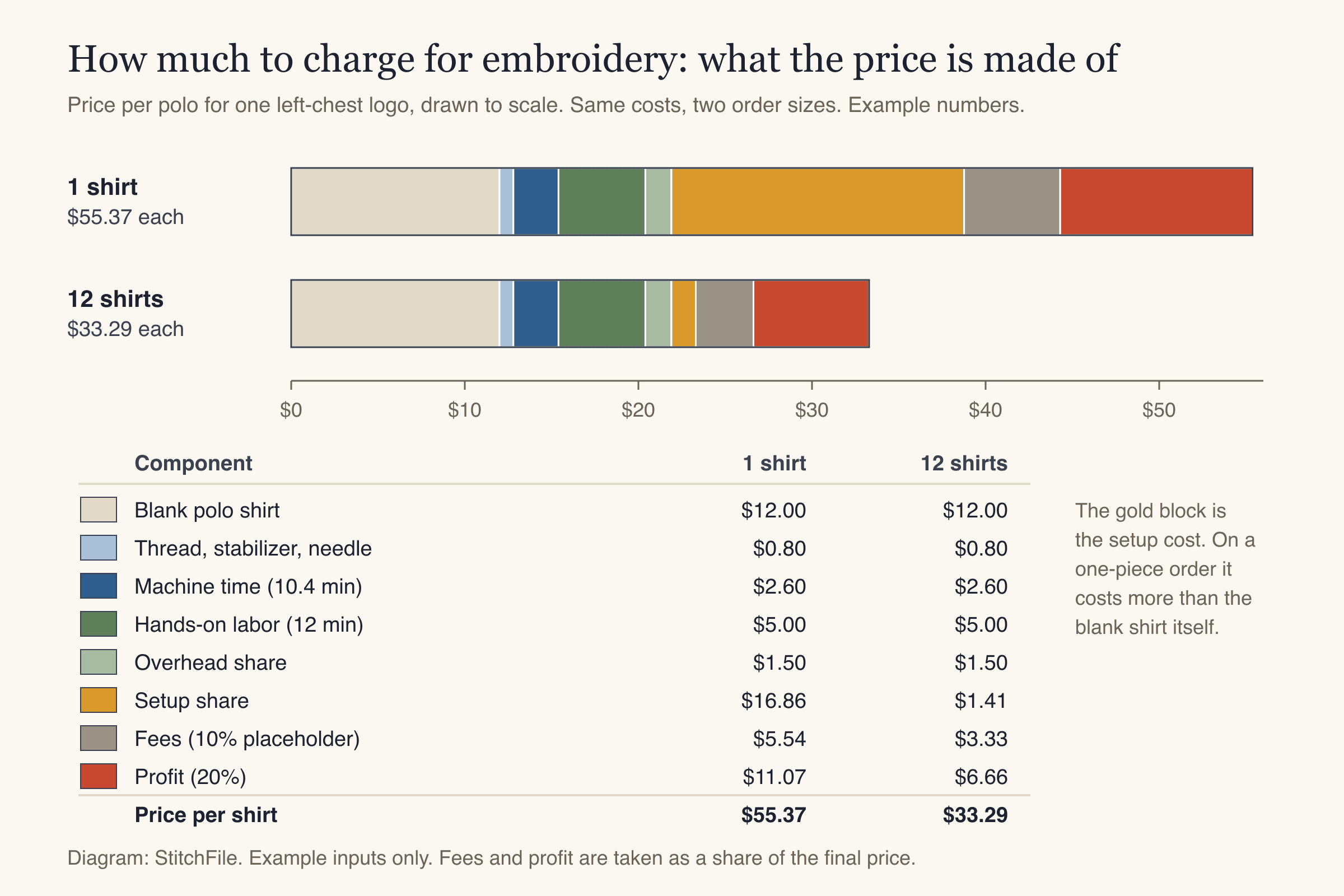
Same costs, two order sizes, drawn to scale. Only the setup share, and the fees and profit calculated on it, change.
Two things stand out. On a one-piece order the setup costs more than the shirt. And machine time is one of the smaller blocks: on a left-chest logo, your hands cost more than your machine.
Embroidery cost per stitch: calibrate your own rate
Many shops quote per 1,000 stitches, and customers searching for embroidery cost per stitch expect it. It's a useful model if you calculate the rate from your own costs and remember what it leaves out. The stitch rate should only cover what grows with stitches: sewing time.
- Cost per sewing minute = machine rate ÷ 60. Example: $15 ÷ 60 = $0.25.
- Minutes per 1,000 stitches = sew minutes ÷ (stitches ÷ 1,000). Example: 10.4 ÷ 5.083 = about 2.05. Use your own timed sew-outs where you can.
- Cost per 1,000 stitches = $0.25 × 2.05 = about $0.51.
- Price per 1,000 stitches = $0.51 ÷ 0.70 = about $0.73.
That rate alone prices the bee logo at about $3.71, nowhere near enough. The rest comes from separate lines:
| Price line | Calculation | Example |
|---|---|---|
| Garment | $12.00 ÷ 0.70 | $17.14 per piece |
| Handling (consumables, labor, overhead) | ($0.80 + $5.00 + $1.50) ÷ 0.70 | $10.43 per piece |
| Stitches | 5.083 × $0.73 | $3.71 per piece |
| Setup | $16.86 ÷ 0.70 | $24.09 per order |
For 12 shirts: $17.14 + $10.43 + $3.71 + ($24.09 ÷ 12) = $33.29, the same as the formula, because it's the same costs arranged differently.
The lesson: a stitch rate without a per-piece handling charge badly undercharges small designs, because hooping and finishing don't shrink with the stitch count. If you sit at a single-needle machine for the whole run, add your labor rate to the sewing-minute cost and take that time out of handling so it isn't counted twice. A multi-needle machine changes the math, since you can hoop the next piece while one sews; see single vs multi-needle embroidery machines.
Quantity breaks: build your own embroidery pricing chart
Quantity discounts aren't generosity. They're the setup cost shared by more pieces. Run the formula at each quantity and you have an honest embroidery pricing chart.
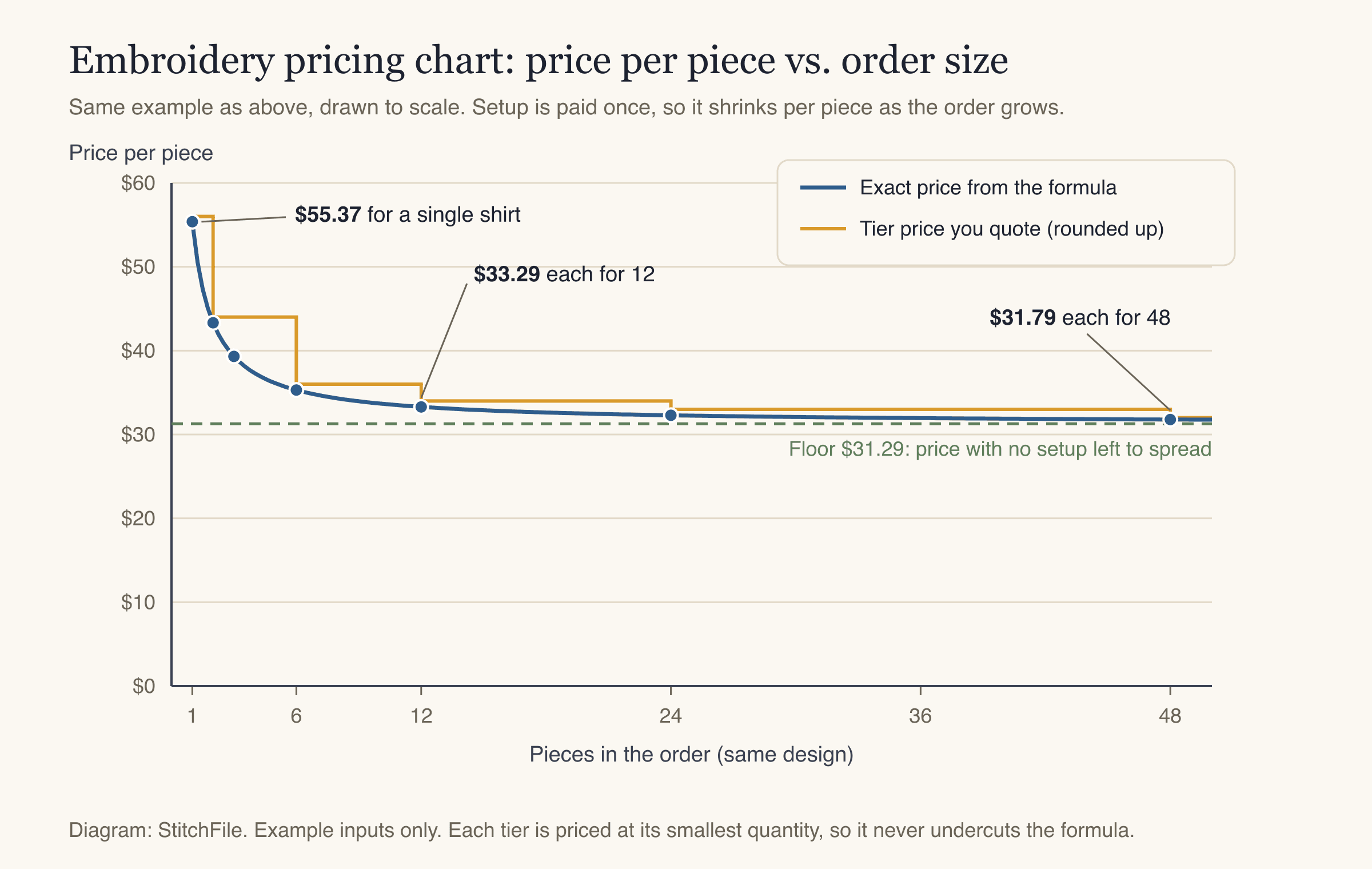
Price per piece against order size for the example. The curve flattens fast: after about a dozen pieces, setup is a small part of the price.
| Quantity (same design) | Formula price at the tier's smallest quantity | Tier price you quote (example) |
|---|---|---|
| 1 | $55.37 | $56 |
| 2–5 | $43.33 | $44 |
| 6–11 | $35.30 | $36 |
| 12–23 | $33.29 | $34 |
| 24–47 | $32.29 | $33 |
| 48+ | $31.79 | $32 |
Price each tier at its smallest quantity and round up, so a customer at the bottom of a tier never pays less than the job costs. The floor ($31.29 here) is the price with no setup left to spread; you can't go below it without cutting your wage or your margin.
The chart covers one design in one location. A second location, like a sleeve or back neck, is a second setup and a second run, so price it as its own line.
Digitizing and setup fees: when they apply
Customers often see the setup line as a "digitizing fee" or "setup fee." Show it separately or fold it into the price, but charge it once per new design:
- New design: charge it. It covers the file, the proof and the test sew-out.
- Repeat order, same file and size: drop the file and most of the proofing; keep a smaller charge for threading and a quick test.
- Same design, new size or fabric: treat it as a new file. A 90 mm left-chest file shouldn't be shrunk to a 55 mm cap on the machine; our polo shirt embroidery guide explains why fabric settings matter too.
With a StitchFile plan the file part is small. Most of the fee is your time: checking the preview, sending a proof and sewing the test.
Names, rush, customer garments and minimums
Names and personalization. Each different name is a different stitch file and sew-out. Colors and placement usually stay the same, so the setup is shorter than for a new logo, but not free. Price a per-name charge from the minutes it adds: making and checking the file, re-loading the machine, and matching each name to the right piece. If you make each name file from artwork in StitchFile, each one is a separate design (one credit on Pro or Shop). Keep letters at least about 5 mm tall on woven fabric and 6 mm on knit and piqué; see our lettering and fonts guide.
Rush orders. A rush pushes other work aside or costs you evenings. Charge a percentage of the order (your own figure) or a flat fee, apply it to the whole order, and only offer turnarounds you can deliver.
Customer-supplied garments. You lose the garment line but take on risk: an unfamiliar fabric, no spare to test on, and a piece you can't replace. Charge a higher handling line instead of a garment markup, ask for a spare or test on similar fabric, agree in writing what happens if a garment is damaged, and decline items you can't hoop safely.
Minimums. A minimum protects you from jobs where setup eats the profit. In the example, one shirt at $55.37 already covers its setup. If you'd rather not sew single pieces, set a minimum quantity or a minimum order value.
Common mistakes when pricing embroidery
- Copying someone else's embroidery prices. Their price carries their costs, speed and fees.
- Marking up instead of using margin. $23.30 × 1.30 = $30.29 looks like "30% on top," but after 10% fees and 20% profit taken from the price you need $33.29. The $3 gap comes out of your pocket on every shirt.
- Pricing on stitches alone. Small designs need a per-piece handling charge.
- Assuming 700 stitches per minute on a slower machine. Time a real sew-out.
- Giving setup away. On a one-piece order it can cost more than the garment.
- Paying yourself "what's left." Put your hourly rate in as a cost, then add profit.
- Using personal-use files for products you sell. StitchFile single designs and 10-packs are personal use; selling needs Pro or Shop.
FAQ
How much should I charge for embroidery?
Charge your per-item cost plus a share of the order's setup, divided by (1 − your fee % − your profit %). The per-item cost is the garment, consumables, machine time, hands-on labor and an overhead share. Because every shop's costs differ, work it out from your own inputs rather than a "going rate."
How do I calculate embroidery cost per stitch?
Divide your machine rate by 60 for a cost per sewing minute, multiply by the minutes it takes to sew 1,000 stitches, then divide by (1 − fee % − profit %). In this guide's example that gives about $0.73 per 1,000 stitches. Always pair it with a per-piece handling charge, because hooping and finishing don't depend on stitches.
Should I charge a digitizing or setup fee?
Yes, once per new design: it covers the stitch file, the proof and a test sew-out. On repeat orders with the same file and size, drop the file part and keep a smaller setup charge. Show it as its own line or fold it into a minimum order, but make sure it's in the price.
How much should I charge to embroider a name?
Time the extra work a name adds (making and checking the file, re-loading the machine, matching it to the right piece), multiply by your hourly rate, and add materials and machine time. Each different name is its own file and sew-out. Keep letters at least about 5 mm tall on woven fabric and 6 mm on knits and piqué.
Why does one embroidered item cost more than a bulk order?
Setup is paid once per order. One piece carries all of it; 12 pieces each carry a twelfth. In the example, the same shirt costs $55.37 alone and $33.29 each in an order of 12.
How do I price embroidery on Etsy?
Use the same formula with your marketplace and payment fees as the fee percentage, taken from Etsy's current fee pages for your shop. Fixed charges such as listing fees can go into overhead. For personalized listings, build a per-name charge into the price or add it as an option.
Price your next order
Fill in the worksheet once and every quote after that is a few minutes of arithmetic. The input that changes most is machine time, and that comes from the design. Upload the customer's logo to StitchFile, choose the size and fabric, and the free preview gives you the stitch count, thread colors and sew time for your quote before you buy the file. Every download includes PES, DST, JEF, EXP and VP3.