Embroidery guide
Embroidery Stitch Count: How to Estimate Stitches and Sew Time
Embroidery stitch count explained with real engine data: how stitches grow with size, a simple estimator, and how long embroidery really takes to sew.
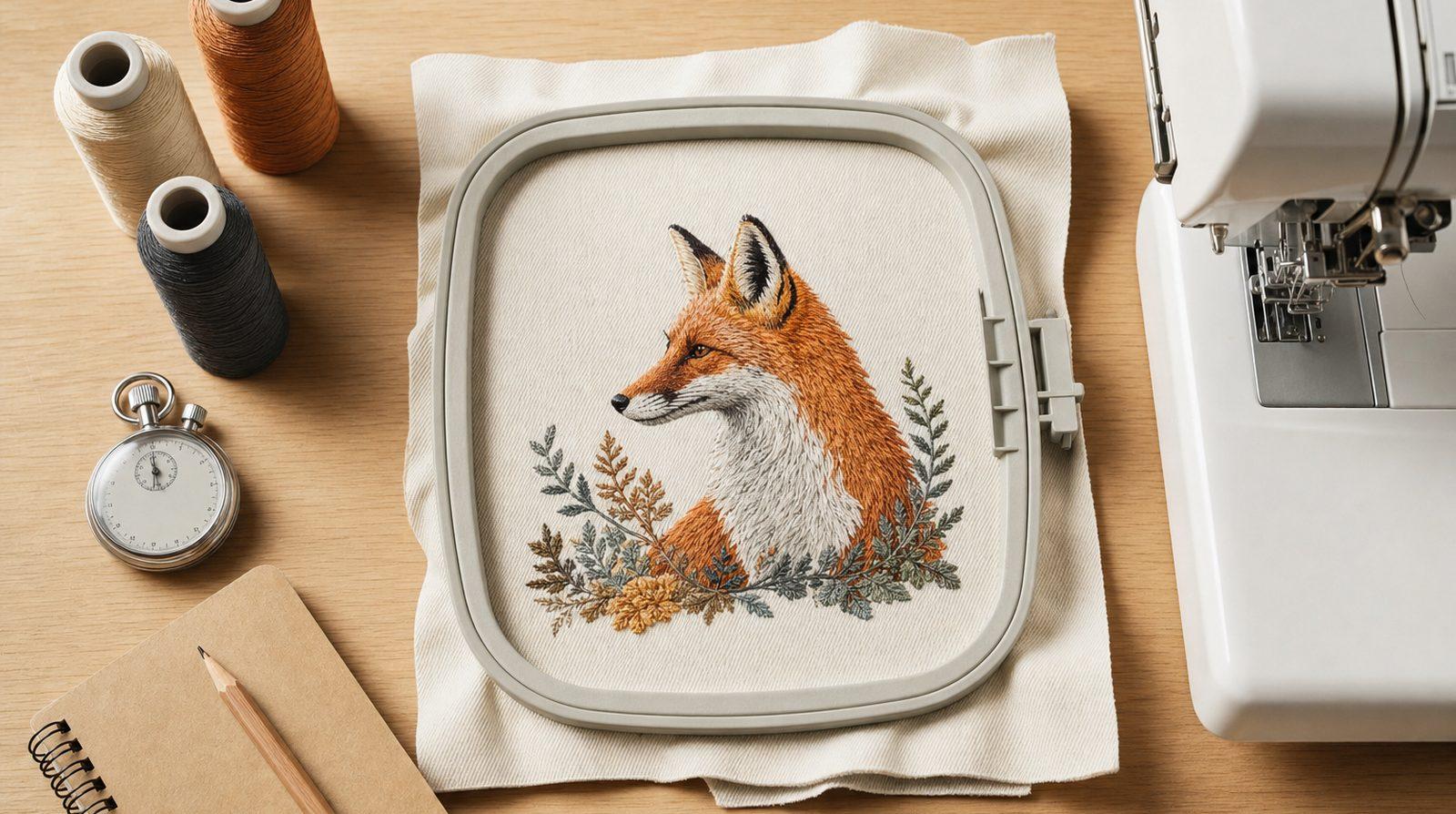
Embroidery stitch count is the number of stitches in a machine embroidery file. It decides how long a design takes to sew, how stiff it feels and, in many shops, what it costs. This guide uses measured numbers: we ran the StitchFile engine on 15 sample designs and three test shapes, at sizes from 30 to 200 mm and on every fabric preset, and read the results from the report files.
Quick answer
- A mostly filled design about 3.5 in (90 mm) wide came out at 7,500–11,800 stitches in our runs. Line art at the same size: about 2,000.
- Fill grows with area: double the size, roughly 4× the stitches. Outlines grow with length: closer to 2–3×.
- Quick estimate: width × height in square inches × about 900 for a solidly filled design.
- Sew time ≈ stitches ÷ machine speed + trims + color changes. 10,000 stitches is about 14 minutes of sewing at 700 stitches per minute.
What stitch count means in embroidery
One stitch is one move of the needle to the next point, so a 10,000-stitch design goes through the fabric about 10,000 times. (In cross-stitch, "count" means the fabric, as in 14-count Aida.) Stitch count drives sewing time, the feel of the finished piece (more stitches in the same area means stiffer), and price, since many shops quote per 1,000 stitches.
Where to find the stitch count
- On the machine. Many computerized embroidery machines show stitch count, colors and often an estimated time when you select a design.
- In the file information. Desktop embroidery software shows it in the design info panel, and DST files carry a header with the stitch count and number of color changes.
- In StitchFile. The free preview shows stitches, colors, trims, size, sew time at 700 stitches per minute and the smallest hoop. The same numbers top the thread color key in the download.
How we measured
We ran the StitchFile engine (the one behind the website) on license-safe sample artwork plus three test shapes we drew: a filled disc, a disc with a satin border, and a ring. Unless noted, the fabric is Woven: fill rows 0.33 mm apart, 3.5 mm fill stitches, underlay rows 1.2 mm apart. Other digitizers use other settings and get different counts, so treat these as one consistent, measured reference.
How stitch count changes with size
A design twice as wide does not get twice the stitches.
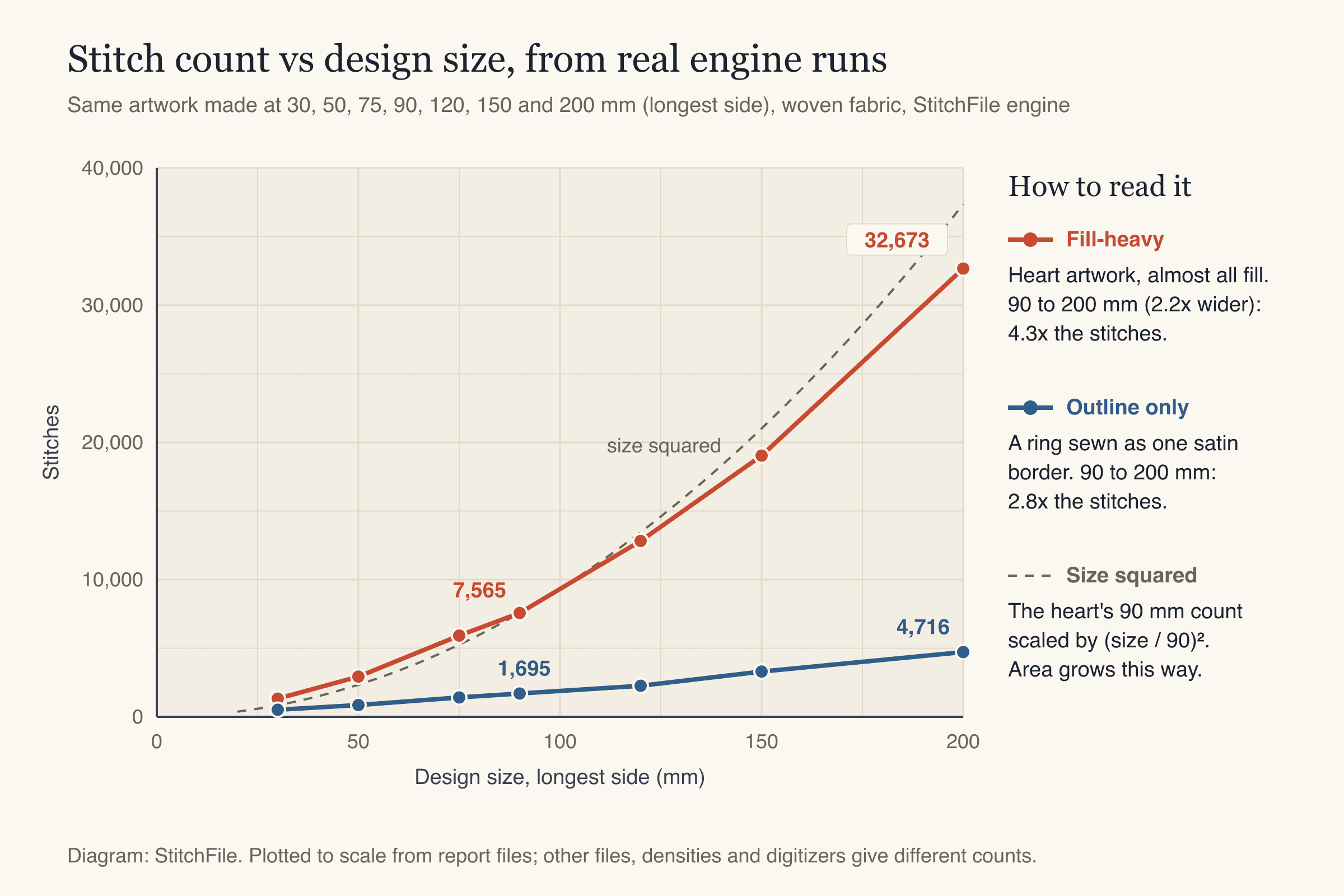
Stitch count vs size from real engine runs. The filled heart follows the size-squared curve closely; the outline-only ring grows almost in a straight line.
| Design (woven) | 30 mm | 50 mm | 75 mm | 90 mm | 120 mm | 200 mm | 90 → 200 mm |
|---|---|---|---|---|---|---|---|
| Filled disc (test shape) | 1,047 | 2,572 | 5,564 | 7,875 | 13,829 | 37,234 | 4.7× |
| Heart (almost all fill) | 1,323 | 2,933 | 5,921 | 7,565 | 12,816 | 32,673 | 4.3× |
| Spool of thread (fill + outlines) | 2,156 | 4,018 | 7,988 | 9,979 | 15,081 | 40,562 | 4.1× |
| Fox (fill + outlines) | 2,163 | 4,011 | 7,632 | 10,145 | 14,688 | 38,454 | 3.8× |
| Paperclip (one thick line) | 633 | 1,120 | 1,682 | 2,043 | 5,293 | 11,812 | 5.8× |
| Ring (satin outline, test shape) | 514 | 861 | 1,411 | 1,695 | 2,262 | 4,716 | 2.8× |
From 90 to 200 mm, a design gets 2.2 times wider and 4.9 times larger in area. Four patterns stand out:
- Fill follows area. The disc grew 4.7×: twice the width and height means twice the rows, each twice as long.
- Outlines follow length. Satin stitches march along a border at a fixed spacing, so the ring grew 2.8×, nearer the 2.2× length increase (wider columns get more underlay).
- Small designs carry overhead. At 30 mm the fox has about twice what size-squared scaling predicts (2,163 vs about 1,127). Locks, edge runs and outlines don't shrink.
- Lines can switch to fill. The paperclip grew about 22 stitches per mm of size while sewn as a satin line. At 120 mm its line was about 5 mm wide, StitchFile sewed it as fill, and the count jumped from 2,043 to 5,293. The fox's outlines did the same at 200 mm.
Trims grow too: the fox had 16 at 30 mm and 62 at 200 mm, because longer gaps between parts get trimmed instead of hidden under later stitching.
What adds stitches to a design
Every filled shape is built in layers. We counted each one during an engine run of a 90 mm disc with a 2.7 mm satin border.
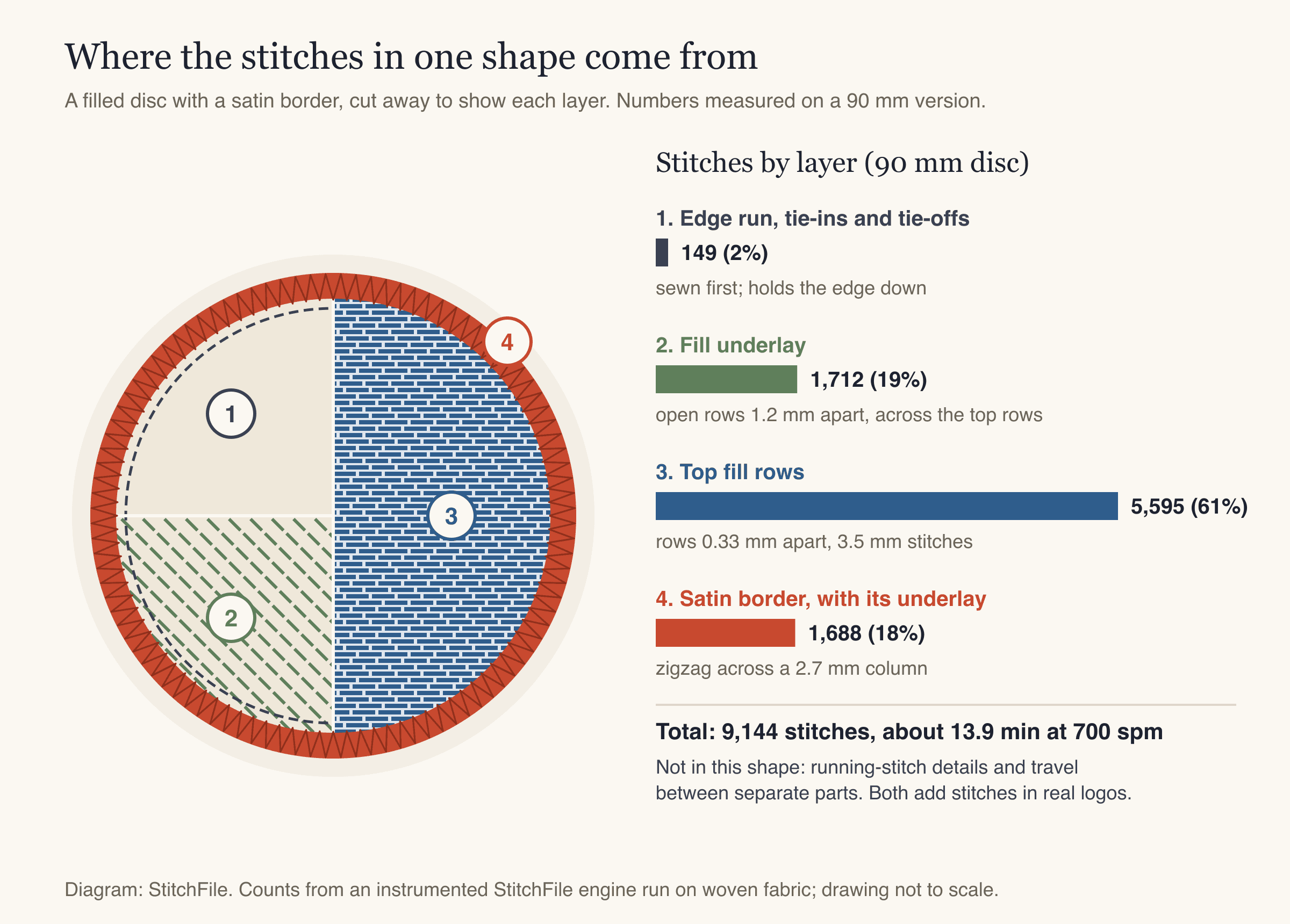
A filled shape is built in layers. In this 90 mm disc, the visible top rows are only 61% of the stitches.
- Top fill rows (61%). About 30 rows per cm times about 3 stitches per cm of row: roughly 87 per cm², plus a needle point at each row end.
- Underlay (19%). Open rows sewn first, across the top rows, to hold the fabric and lift the top stitches: about 28 per cm².
- Satin border (18%). A zigzag landing every 0.4 mm on each edge: about 50 stitches per cm of border, plus its own underlay.
- Edge run and locks (2%). A running line around the shape before the fill, plus tie-in and tie-off stitches.
Real logos add two more: running stitches for fine lines (StitchFile's 2 mm stitch gives about 5 per cm per pass; a triple run is three passes) and travel stitches that move the needle between parts of one color, hidden under later stitching.
Fill-heavy and outline-heavy art, both 90 mm:
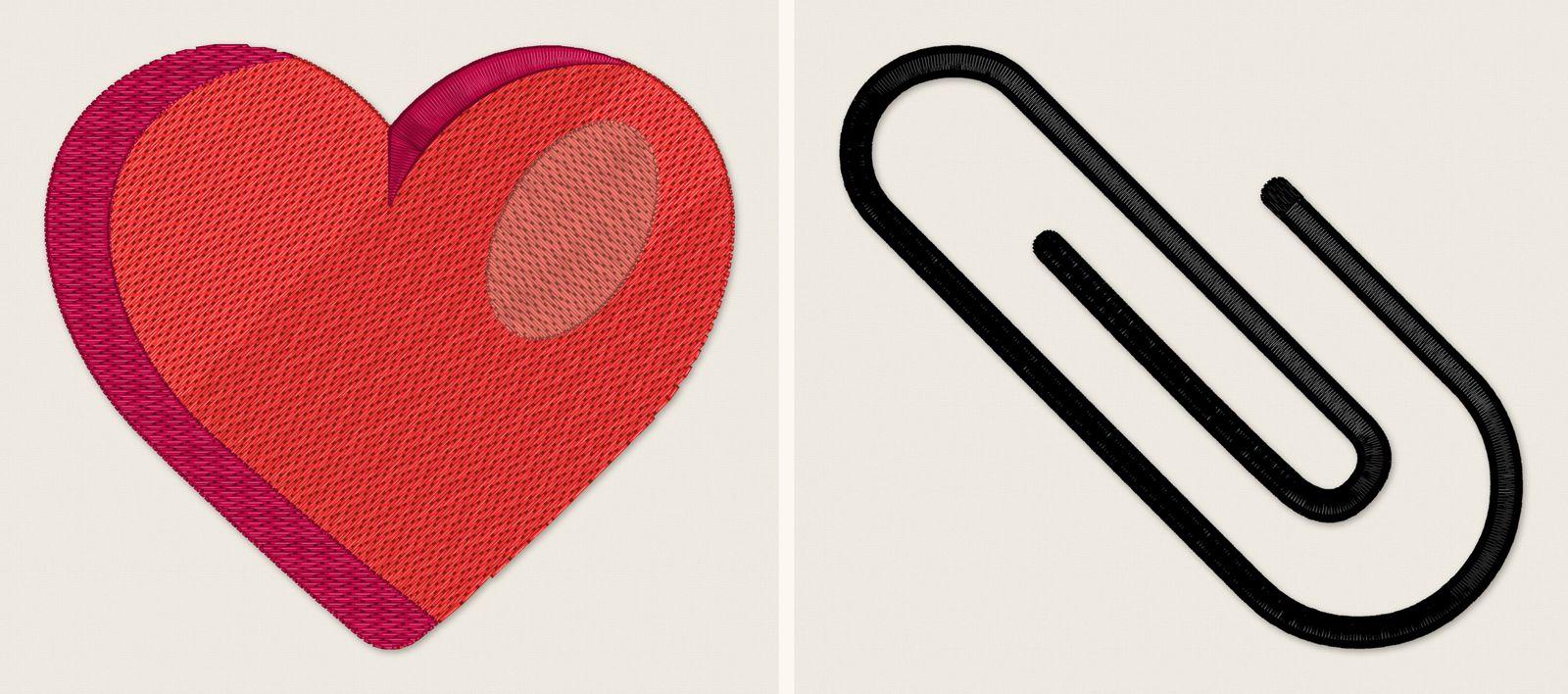
StitchFile stitch previews on woven fabric. Left: heart, 89.5 × 78.3 mm, 7,565 stitches, 3 colors, 10 trims, about 12.8 minutes at 700 stitches per minute. Right: paperclip, 89.4 × 78.9 mm, 2,043 stitches, 1 color, 2 trims, about 3.1 minutes.
Heart artwork: Microsoft Fluent Emoji, copyright (c) Microsoft Corporation, MIT License. Paperclip artwork: OpenMoji paperclip, CC BY-SA 4.0. StitchFile converted both into the stitch previews shown here; these adaptations are shared under the same licenses.
More on how these stitch types are built: satin vs fill stitch.
Fabric and density change the count
Density is how close the rows sit. Stretchy fabrics get lighter fill so they don't pucker; fuller fill packs rows closer so less fabric shows. Same artwork at 90 mm:
| Design at 90 mm | Woven | Denim | Towel & fleece | Polo piqué | T-shirt knit | Woven, fuller |
|---|---|---|---|---|---|---|
| Fill row spacing | 0.33 mm | 0.33 mm | 0.33 mm | 0.42 mm | 0.45 mm | 0.30 mm |
| Heart | 7,565 | 7,638 | 7,568 | 6,122 | 6,047 | 8,122 |
| Fox | 10,145 | 10,138 | 10,118 | 8,735 | 8,322 | 10,696 |
| Paperclip | 2,043 | 2,031 | 2,020 | 2,021 | 1,814 | 2,045 |
StitchFile's woven, denim and towel presets share the same fill rows, so their counts stay within about 1% (towel differs in pull compensation and topping). The knit preset cut the heart by 20%; fuller fill added 5–7%. The paperclip barely moved, because a satin line has no fill rows.
How to estimate embroidery stitch count
These are the rates we measured (running stitch is calculated from its length):
| Element (StitchFile woven standard) | Per cm | Per inch |
|---|---|---|
| Fill (discs 90–200 mm; smaller shapes run higher) | 119–125 per cm² | 770–810 per in² |
| Fill on the T-shirt knit preset | about 94 per cm² | about 610 per in² |
| Satin border, 0.9–3.6 mm wide | 57–62 per cm of length | 145–158 per inch |
| Satin border, 4.5–6 mm wide | 72–78 per cm of length | 184–197 per inch |
| Running stitch, one pass | about 5 per cm | about 13 per inch |
Other digitizers' settings give other rates.
Method 1: the area method
This is the arithmetic behind any embroidery stitch count estimator or stitch count calculator:
- Measure the finished size, width × height.
- Estimate how much of that box is filled. A round logo fills about 78% of its box, a heart about 70%, a star under half.
- Multiply the filled area by the fill rate: about 800 per in² (125 per cm²) on woven, about 600 per in² on knits.
- Add outlines and lines: satin length × about 150 per inch; running lines × about 13 per inch per pass.
- Add 10–20% for layered colors, small pieces, locks and travel.
Worked example, the 90 mm heart: the box is 89.5 × 78.3 mm, or 70.1 cm². About 70% is filled: 49 cm² × 125 = 6,125. No drawn outlines. Three overlapping colors, so add 20%: about 7,350. The engine's real count was 7,565, 3% higher.
Method 2: the quick rule of thumb
Multiply width × height in square inches by about 900 for a design that fills most of its box. Across 12 solidly filled samples at 90 mm, the real figure ran from 670 to 1,070 per square inch of box, median about 900:
| Sample at 90 mm | Size (mm) | Box (in²) | Stitches | Per in² of box |
|---|---|---|---|---|
| Fox | 70.9 × 89.4 | 9.8 | 10,145 | 1,033 |
| Teacup | 85.4 × 89.2 | 11.8 | 11,797 | 999 |
| Spool of thread | 89.5 × 86.3 | 12.0 | 9,979 | 834 |
| Heart | 89.5 × 78.3 | 10.9 | 7,565 | 696 |
| Spider web | 89.4 × 89.5 | 12.4 | 8,285 | 668 |
| Star (open shape) | 89.6 × 85.4 | 11.9 | 6,180 | 521 |
| Paperclip (line art) | 89.4 × 78.9 | 10.9 | 2,043 | 187 |
For 10 of the 12 solid designs, the rule landed within about 16% of the real count; the heart and spider web came in 29% and 35% below it. Use about 500 per in² for open shapes and 200 for line art. Good for a first quote, not a promise.
To rescale an estimate, multiply a fill-heavy count by (new size ÷ old size)² and an outline-heavy one by roughly new size ÷ old size. Most real logos land in between.
Check the real number before you sew
The real count comes from the finished file. StitchFile makes it from your artwork in about 20 seconds: upload an SVG, PNG or JPG, pick a size preset (left chest 90 mm, cap front 55 mm, patch 75 mm and others) and a fabric, and the free preview shows the stitch count, colors, trims, sew time and smallest hoop. Try 75 mm instead of 90 mm to see what it saves, or use Fewer colours and Remove parts to cut color changes and trims.
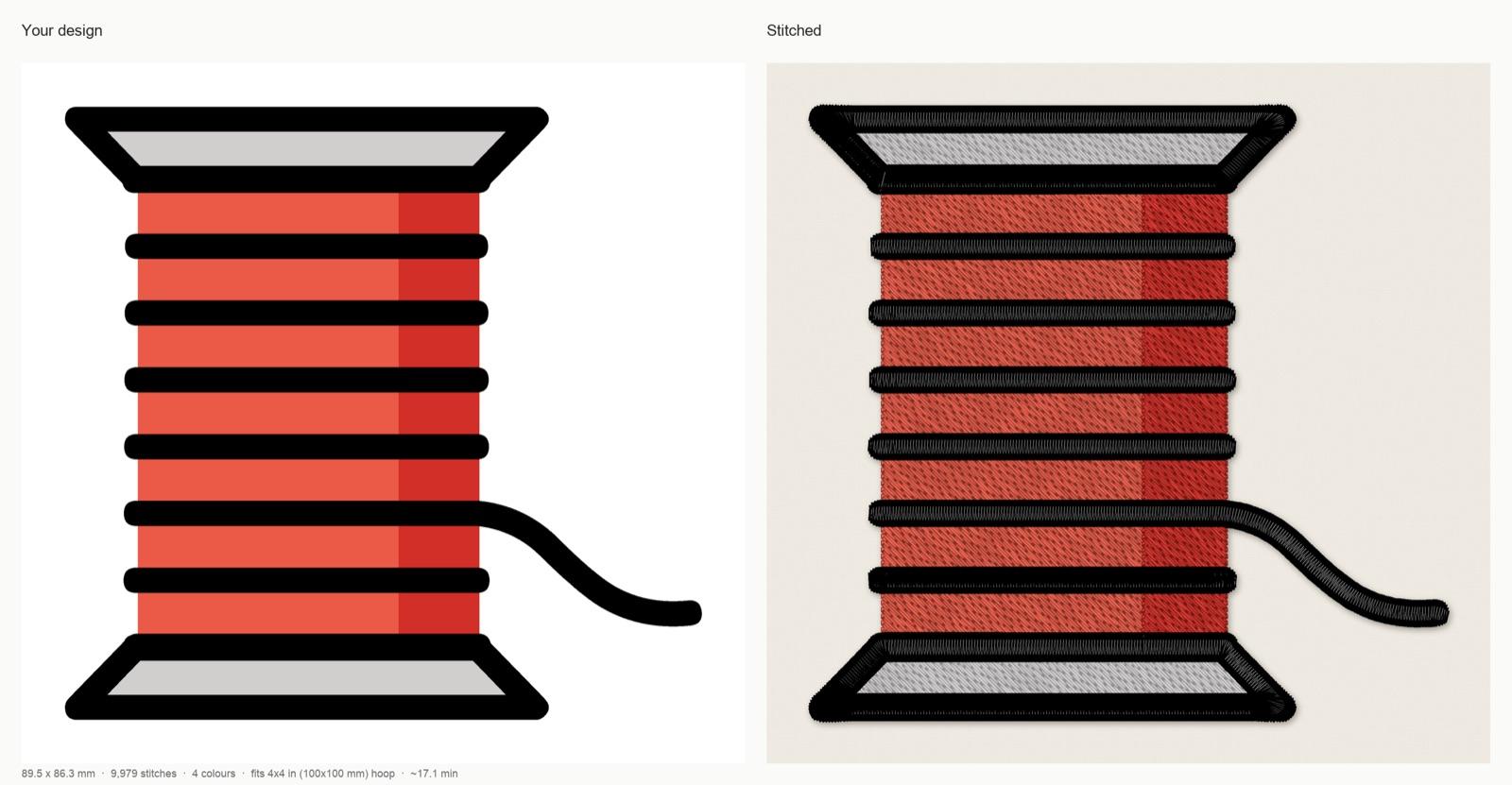
StitchFile stitch preview on woven fabric: 89.5 × 86.3 mm, 9,979 stitches, 4 colors, 13 trims, fits a 4×4 in (100×100 mm) hoop, about 17.1 minutes at 700 stitches per minute.
Artwork: OpenMoji spool of thread, CC BY-SA 4.0. StitchFile converted the artwork into the stitch preview shown here; these adaptations are shared under the same license.
How long does embroidery take?
Sew time ≈ stitches ÷ stitches per minute + trims + color changes
StitchFile's estimate allows 6 seconds per trim and 30 seconds per color change at 700 stitches per minute (spm). For the spool: 9,979 ÷ 700 = 14.3 minutes of sewing, plus 13 trims (1.3 minutes) and 3 color changes (1.5 minutes): 17.1 minutes.
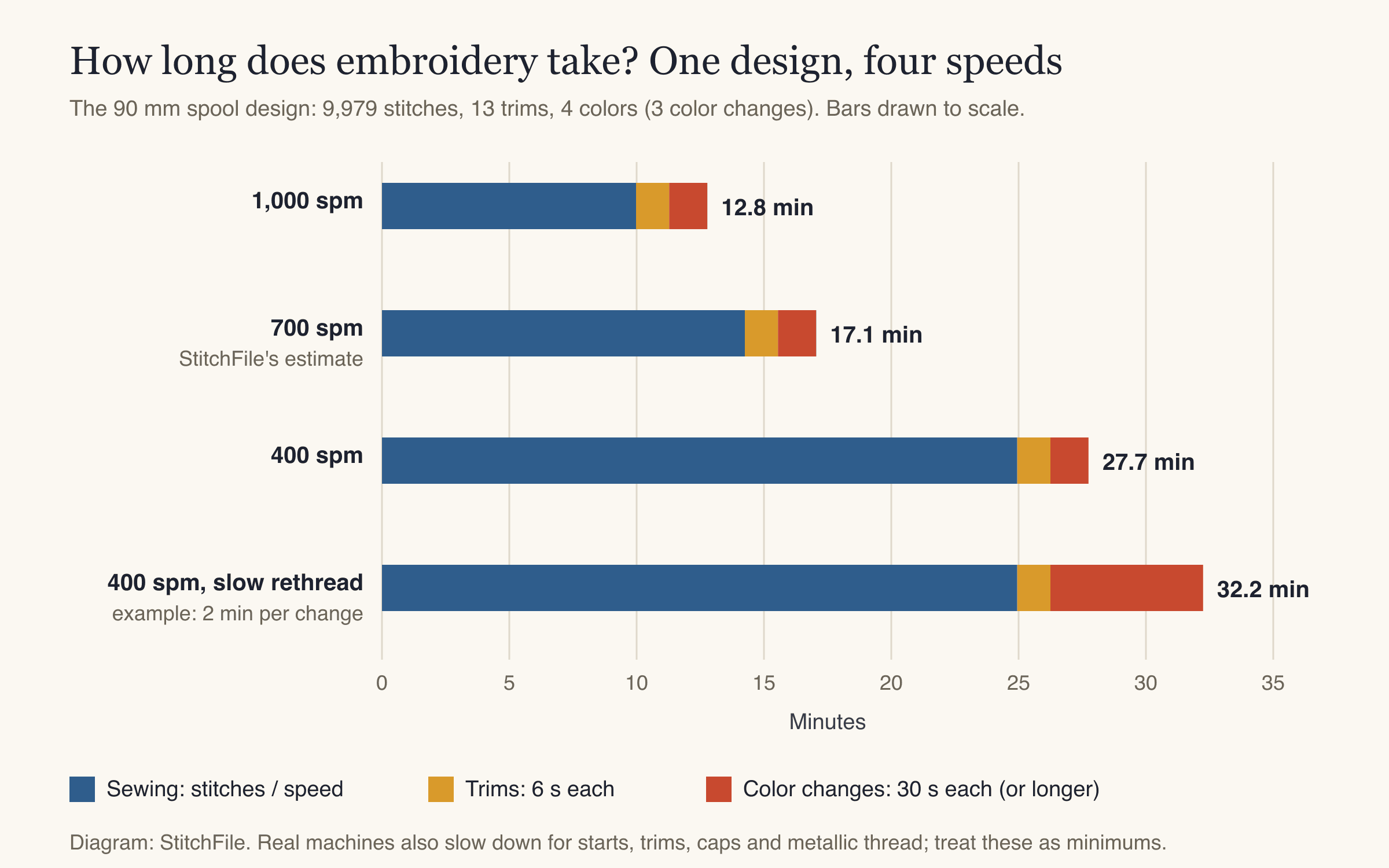
The same file takes 12.8 minutes at 1,000 spm and 27.7 minutes at 400 spm. Slow rethreading on a single-needle machine adds more.
Size changes time quickly: the fox takes 6.2 minutes at 30 mm, 18.9 at 90 mm and 62.6 at 200 mm.
Why real machines sew slower than the estimate
Home single-needle machines commonly top out between about 400 and 1,000 spm, depending on the model; many multi-needle machines are rated around 1,000 to 1,200. Real jobs run slower:
- Caps sew best at reduced speed on a cap frame (see how to embroider a hat).
- Metallic and specialty threads break and shred less at lower speed.
- Small lettering and fine detail mean many short stitches and direction changes.
- Thick or plush fabrics such as towels and jackets are easier on needles at lower speed.
- Single-needle machines stop at each color for you to rethread. At two minutes per change, the spool goes from 27.7 to 32.2 minutes at 400 spm.
Time your next sew-out against the estimate and use that ratio for your machine. For volume work, see single vs multi-needle machines.
Stitch count and embroidery pricing
Many shops price per 1,000 stitches, often with a per-item minimum and a setup fee: stitches ÷ 1,000 × your rate. The 9,979-stitch spool costs about ten times your per-1,000 rate, and about four times as much at 200 mm as at 90 mm. Colors, hooping and the garment matter too; see how much to charge for embroidery.
Common mistakes
- Scaling estimates by width alone. A fill-heavy design twice as wide has about four times the stitches.
- Resizing a stitch file on the machine. The count stays the same, so rows spread apart when enlarged and pack too tight when shrunk. Make a new file at the new size; see logo placement and size for common sizes.
- Thinking more stitches means better quality. Too dense makes embroidery stiff, breaks thread and puckers fabric.
- Leaving out trims and color changes. The hiking gopher, with 14 color stops and 60 trims, takes 25.3 minutes for 8,926 stitches; the spool takes 17.1 for 9,979.
- Comparing counts across digitizers. Different row spacing, stitch length and underlay give different counts. Stitch count also says nothing about fit; check the hoop size guide.
FAQ
How many stitches is a typical left chest logo?
In our runs, mostly filled designs about 90 mm (3.5 in) wide came out at 7,500 to 11,800 stitches. Open designs were around 5,600 to 6,200, and simple line art around 2,000.
How do I calculate embroidery stitch count?
Multiply the filled area by about 800 stitches per square inch, add satin outlines at about 150 per inch and running lines at about 13 per inch per pass, then add 10–20%. For a quick check, use width × height in square inches × about 900.
How long does it take to embroider 10,000 stitches?
At 700 stitches per minute, about 14.3 minutes of sewing, plus about 6 seconds per trim and 30 seconds or more per color change. At 400 stitches per minute, the sewing alone takes 25 minutes.
Does doubling the size double the stitch count?
Not for filled designs. Fill grows with area, so doubling the size gives roughly four times the stitches. Outlines grow with length and come closer to double, until lines get wide enough to be sewn as fill.
How much does embroidery cost per stitch?
Shops usually price per 1,000 stitches, often with a per-item minimum and a setup fee, and rates vary by region and quantity. Divide the stitch count by 1,000 and multiply by the rate for the stitch part of the price.
Is embroidery stitch count the same as cross-stitch count?
No. In machine embroidery, stitch count is the number of stitches in the design file. In cross-stitch, "count" describes the fabric, such as 14-count Aida with 14 squares per inch.
Get a real stitch count for your design
Upload your logo or artwork to StitchFile, choose the size and fabric, and the free preview shows the exact stitch count, colors, trims, sew time and smallest hoop before you buy. Every purchase includes PES, DST, JEF, EXP and VP3 files and a thread color key.