Embroidery guide
Machine Embroidery Thread Guide: Types, Weights and Colors
Machine embroidery thread explained: polyester vs rayon, 40 vs 60 weight, bobbin thread, color charts and brand conversion, plus fixes for shredding.
Quick answer:
- For most projects, use 40 weight polyester machine embroidery thread. It's strong, colorfast and survives hot washes and bleach. Rayon is a little glossier but less tough.
- Put bobbin thread (usually 60 or 90 wt, white or black) in the bobbin, not your top colors.
- Most design files are made for 40 wt. Thinner 60 wt thread needs a file digitized for it, or fabric shows between the rows.
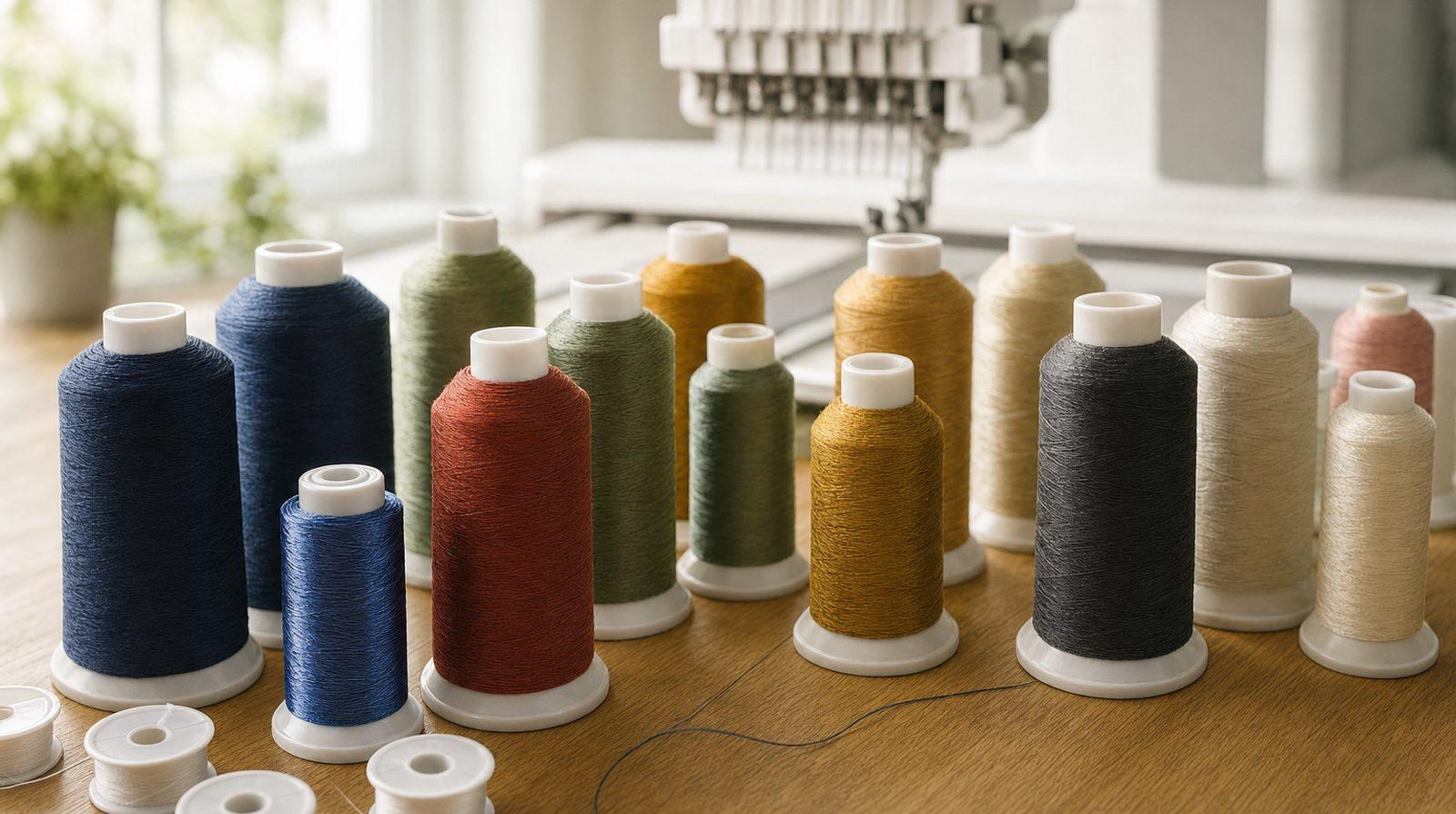
- Beginners need about 12 to 15 colors. To match a brand color, use a thread color chart or conversion chart, then test-sew.
Machine embroidery thread is the thread that runs through the needle of an embroidery machine: thin, smooth, glossy, and wound on spools or cones. The choices on the label (fiber, weight, spool type) decide how your design looks, how it survives the wash, and how often the thread breaks.
This guide explains each choice, how color charts and conversion charts work, and which stitch-out problems start with the thread.
If you searched for "embroidery thread" and found skeins of six-strand floss, that's for hand embroidery. Floss is too thick and loosely twisted to run through a machine needle at speed, so it isn't used on embroidery machines.
Polyester, rayon, cotton or metallic?
Almost all embroidery machine thread is one of four fibers. Polyester and rayon cover nearly every project; cotton and metallic are for specific looks.
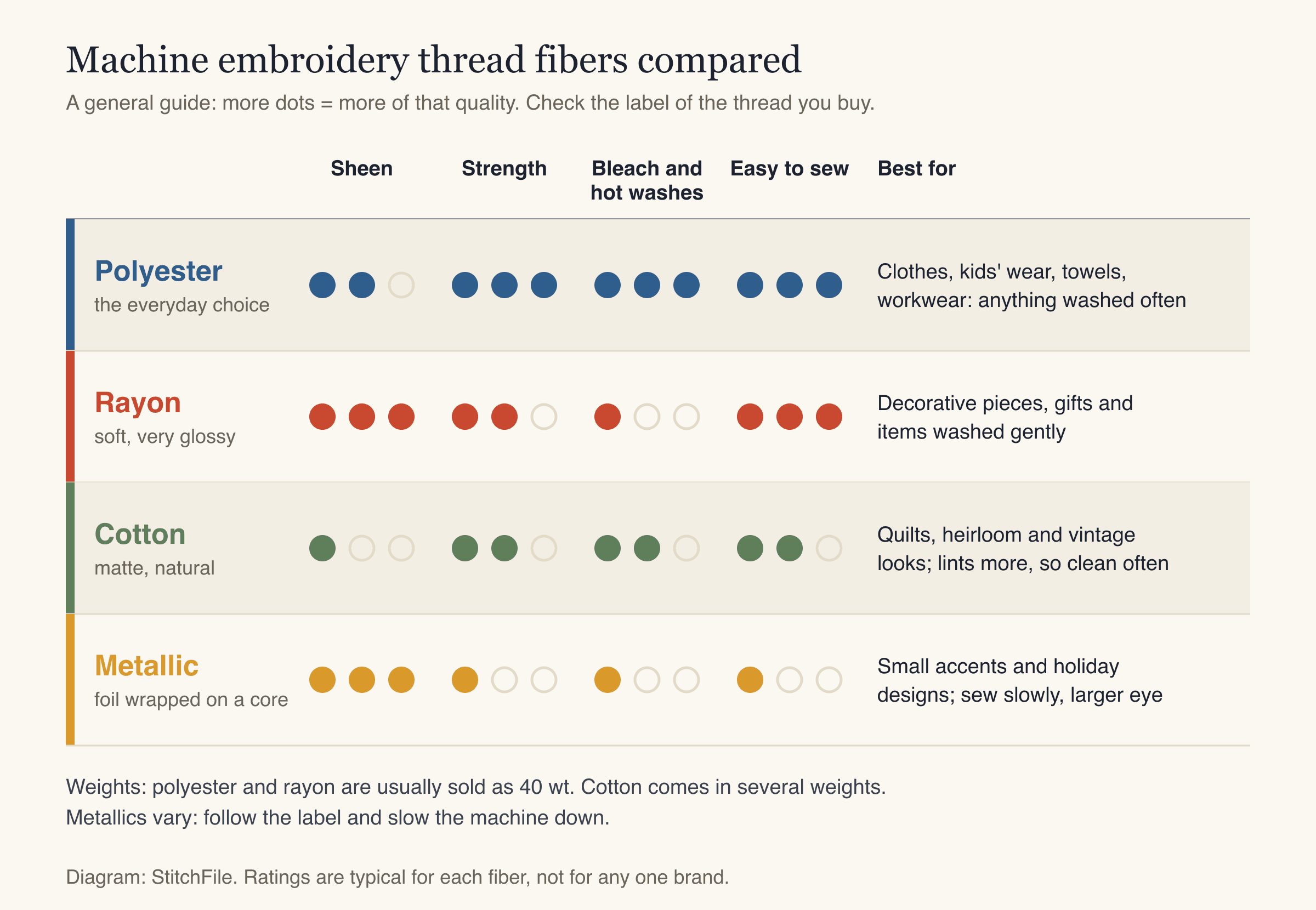
How the four common fibers compare. Polyester is the all-rounder; the others trade toughness for a particular look.
Polyester embroidery thread is the default for a reason. It's strong, so it breaks less at speed, and most is made to stand up to chlorine bleach and hot washes without fading. Its sheen is hard to tell from rayon once stitched. Use it for anything washed often: kids' clothes, towels, uniforms, bags and caps.
Rayon embroidery thread is made from cellulose (wood pulp). It's soft, runs smoothly and has a silky, high sheen that looks lovely in satin lettering. The trade-off: it's weaker than polyester, especially when wet, and bleach and harsh washing can fade it. Choose it for gifts, framed pieces and garments washed gently.
Cotton has a matte, natural finish for heirloom, vintage and quilting projects. It's less strong than polyester and sheds more lint, so clean the bobbin area more often. It comes in several weights; check the label and match the needle to it.
Metallic thread is a core wrapped in thin metallic foil. It sparkles, and it's the fussiest thread to sew. Use it for small accents, not large fills, and give it:
- A needle with a larger eye, such as a metallic or topstitch needle (90/14 is common).
- A slower machine speed and slightly looser top tension.
- A vertical spool pin or a thread stand, so it doesn't twist as it unwinds.
- A design that isn't too dense. Metallic shreds on tight satin and heavy fill.
So what's the best embroidery thread?
For most people, a good-quality 40 wt polyester: it suits the widest range of fabrics and washing and forgives small tension mistakes. Add rayon for gloss on decorative work and a metallic for accents. Buy thread sold as machine embroidery thread; cheap or old thread breaks more.
Machine embroidery thread weight: 40, 60 and 30 wt
Thread weight is the number on the label, such as 40 wt. It's a length-per-weight measure: roughly how many kilometers of thread make up one kilogram. So the higher the number, the finer the thread. 60 wt is thinner than 40 wt; 30 wt is thicker.
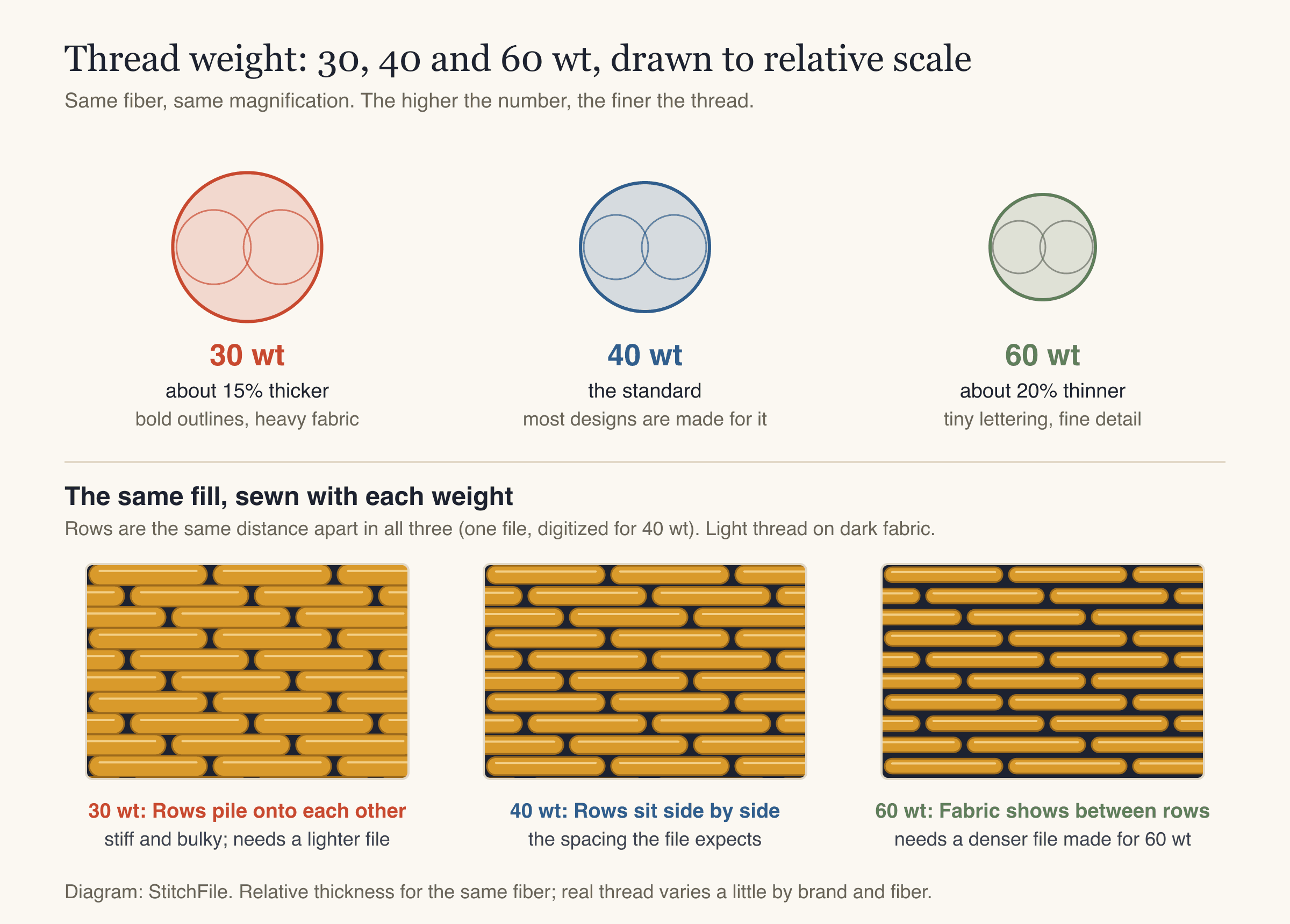
For the same fiber, 60 wt is about 20% thinner than 40 wt and 30 wt about 15% thicker. Sewn from the same file, that difference decides whether the rows cover the fabric.
Brands don't all measure weight identically, so treat the number as a guide.
| Weight | Thickness | Typical use | Common needle |
|---|---|---|---|
| 30 wt | Heavier | Bold outlines, heavy fabric, a hand-stitched look | 90/14 |
| 40 wt | Standard | Almost every design; what most files are made for | 75/11 |
| 60 wt | Finer | Very small lettering and fine detail, in files made for it | 65/9 or 70/10 |
Why weight and density go together
Whoever digitized a design chose a density: how far apart the rows of fill and satin stitches sit. That spacing assumes a thread thickness, and for most files it's 40 wt.
- 40 weight embroidery thread in a 40 wt file: the rows sit side by side and cover the fabric.
- 60 weight embroidery thread in the same file: each row is thinner but just as far apart, so fabric shows through. On a dark garment you see stripes.
- 30 wt in the same file: the rows pile onto each other. The design turns stiff and bulky, and the thread breaks more.
So 60 wt isn't a free upgrade for small text. It works in a file digitized for it, with closer rows and narrower satin columns. For lettering in an ordinary file, a bigger size or a bolder font helps more; our embroidery lettering and fonts guide has minimum letter heights.
For the same reason, don't enlarge a design much on the machine screen: it spreads the rows apart, just like thinner thread. Weight also decides the needle, since thicker thread needs a bigger eye; see the embroidery machine needles guide.
Embroidery bobbin thread
The bobbin thread locks each top stitch into the fabric from underneath. With the tension right it doesn't show from the front, so it needn't match your top colors, but it does need to be the right kind.
- Use thread sold as embroidery bobbin thread. It's usually 60 or 90 wt, finer than the top thread, so more fits on a bobbin, the back stays flat, and the tension balance works as your machine expects. Thicker sewing thread can pull up to the front.
- White or black. White for light fabrics, black for dark ones. When the back will be seen (a towel, a scarf), or when dark thread sews on light fabric or light on dark, a bobbin color close to the top color hides any bit that peeks through.
- Prewound bobbins come filled at the factory. They hold more than most bobbins you wind yourself, but must be the exact size your machine takes (common sizes include class 15 and L-style). Check your manual first.
Check the balance. With balanced tension, the back of a satin column shows about one third bobbin thread down the middle, with top thread on each side. More bobbin means the top tension is too tight; none means it's too loose. The troubleshooting guide walks through the test.
Spools, cones and thread stands
Embroidery machine thread comes in two packages:
- Small spools (often around 1,000 yards) fit a home machine's spool pin: the easy way to build a range of colors.
- Cones (often 5,000 yards or more) cost less per yard and suit black, white and other colors you use constantly, or multi-needle production.
How the thread is wound matters too: thread that twists or catches as it leaves the spool causes breaks and loops.
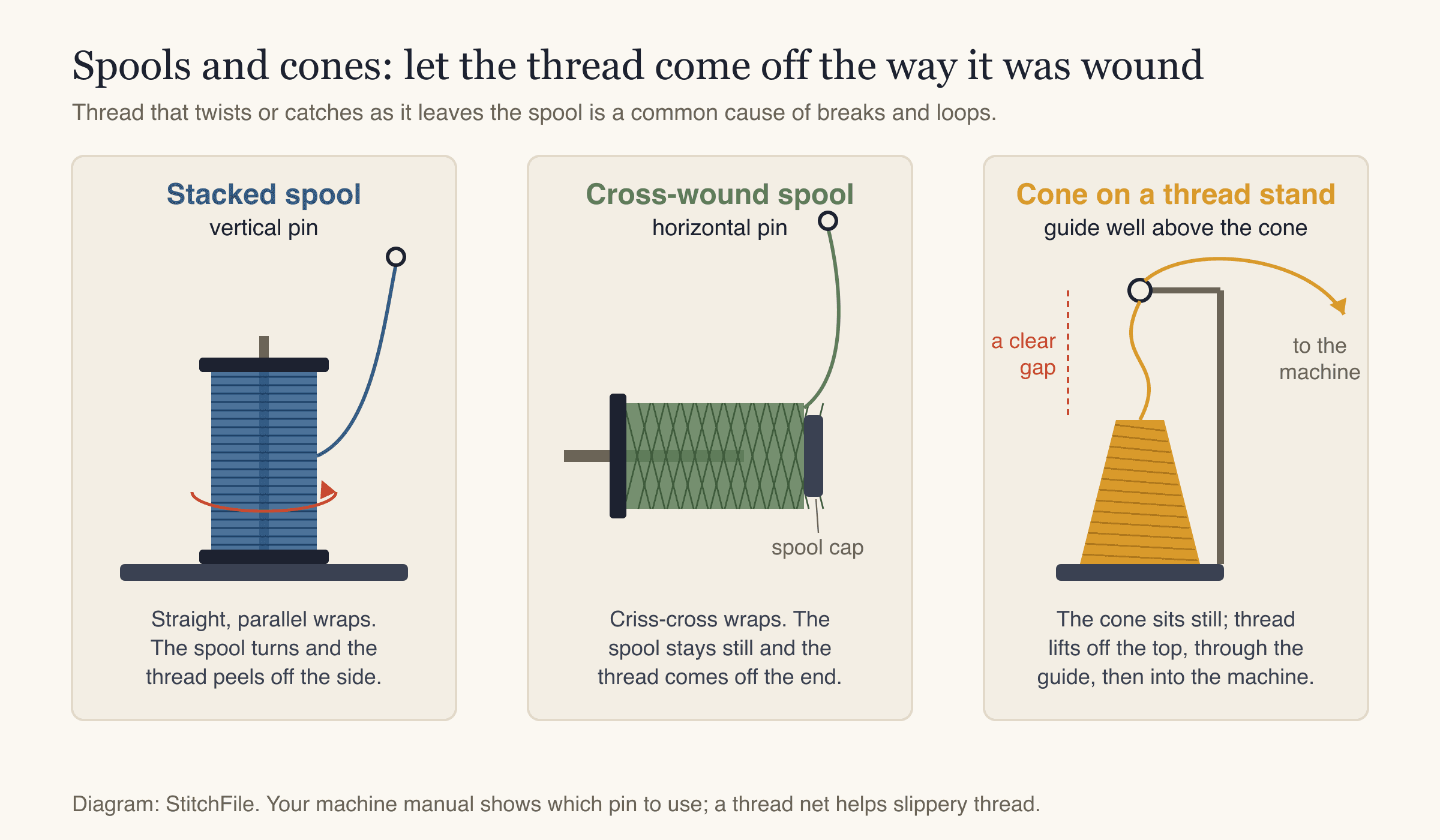
Stacked spools feed off the side on a vertical pin; cross-wound spools feed off the end; cones need a thread stand with a guide well above them.
- Look at the wraps. Straight, parallel wraps mean a stacked spool: put it on a vertical pin so it can turn. Criss-cross wraps mean a cross-wound spool, which feeds off the end and suits a horizontal pin.
- Put cones on a thread stand, behind or beside the machine, never on the spool pin.
- Use a spool cap that fits and turn the spool so the thread can't snag in its notch.
- Add a thread net (a loose mesh sleeve) to slippery thread that slides off and tangles.
How many thread colors does a beginner need?
Fewer than the big boxed sets suggest. Start with about 12 to 15 colors and add what your projects call for:
| Color | Why you need it |
|---|---|
| Black, white | Outlines, lettering, highlights; used in most designs |
| Light gray, dark gray | Shading, silver tones, softer outlines |
| Red, navy, royal blue | Classic logo and team-style colors |
| Kelly green, yellow, orange | Bright accents and flowers |
| Brown, tan | Animals, wood, hair, skin tones |
| Pink, purple | Florals, kids' designs |
| Gold or a metallic | Accents and holiday work |
Buy black and white in larger amounts; they run out first. If a design asks for more colors than you own, merge similar shades. In StitchFile, designs use up to 12 colors, and the free Fewer colours edit reduces that further, merging look-alike colors first.
Embroidery thread colors, color charts and conversion charts
Every thread brand has its own range and its own numbers. That's where most color confusion starts.
An embroidery thread color chart is one brand's list of colors and numbers. Printed and on-screen charts are fine for browsing but don't show shiny thread accurately, and satin looks lighter or darker depending on its direction. For matching, a real thread card with actual thread samples is far more reliable.
An embroidery thread conversion chart lists a color in one brand next to the nearest color in other brands. To use one:
- Find the color in the brand column your design or color key names.
- Read across to your brand's column.
- Treat it as "nearest," not "identical." Brands dye different ranges, some colors have no close match, and charts usually cover only each brand's main line.
- Check it against a thread card or the spool in daylight, next to the fabric.
- Write down the numbers you settle on, so repeat orders match.
Matching brand colors. A brand guide usually gives a Pantone (PMS) number or a hex code, and thread makers often publish charts from print colors to their nearest thread. Look it up, then test-sew on the actual garment color: a red that looks right on white can look different on navy. For a client, show them the test piece first.
How StitchFile handles thread colors
If you turn your artwork into an embroidery file with StitchFile, the matching is done for you. The upload asks for the garment color so the thread choices suit it. The preview shows the thread colors in sewing order, and the color key in your download lists the nearest Brother embroidery thread for each, with "rough match" where no Brother thread is close. Using another brand? Use that brand's conversion chart from the Brother color, or pick the closest thread you own.
Before you buy, Change colours lets you swap any color for one of 64 Brother threads, to match a brand color or the spools you already have, and Fewer colours cuts thread changes. Both are free with a StitchFile account, with a new preview in about 20 seconds. Every color key also reminds you to sew with 40 wt thread, because thinner thread leaves gaps between the rows.
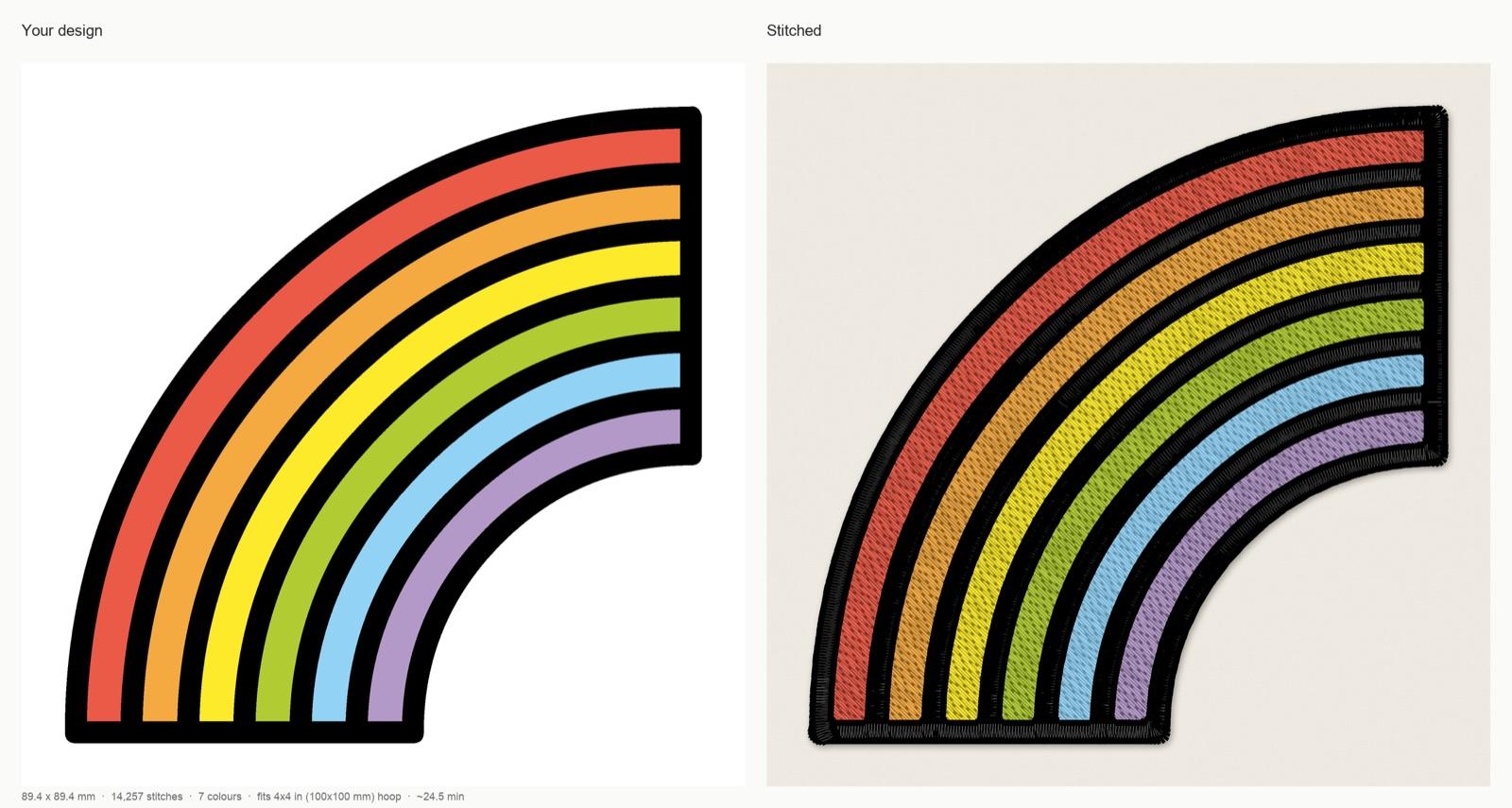
StitchFile stitch preview on the Woven setting at 90 mm: 89.4 × 89.4 mm, 14,257 stitches, 7 thread colors, 11 trims, fits a 4×4 in hoop, about 24.5 minutes at 700 stitches per minute. The color key matches the bands to Brother Vermilion, Pumpkin, Cream Yellow, Fresh Green, Light Blue and Lavender, with Black for the outline, and recommends medium tear-away stabilizer.
Artwork: OpenMoji rainbow, CC BY-SA 4.0. StitchFile converted the artwork into the stitch preview shown here; these adaptations are shared under the same license.
A note on machine screens: PES, JEF and VP3 files store colors, but the machine displays them from its own thread chart, and DST and EXP files don't store colors at all. If the screen colors look wrong, follow the color key. The file formats guide explains why.
Storing thread and how long it lasts
Heat, dry air and light make thread brittle and fade it over time. Rayon and cotton age faster than polyester.
- Keep it out of sunlight, cool and dust-free, in a closed box or drawer. Dust on thread ends up in your tension discs.
- Secure the tails in the spool notch so loose ends don't tangle.
- Test old spools. Pull a length between your hands. If it snaps with little effort, it's brittle and will break mid-design; use it for test-sews or throw it away.
- Buy enough for big orders at once; dye lots can vary slightly.
Thread problems you can trace to the thread
Most stitch-out problems come from threading, tension, the needle or hooping, but some start with the thread.
| Problem | Thread-related cause | What to try |
|---|---|---|
| Shredding (thread frays into fluff near the needle) | Old or brittle thread; needle eye too small for the weight; metallic thread | Fresh thread; a needle sized for the weight (larger eye for metallic); slow down |
| Thread breaking | Thread catching on the spool notch, a nicked spool or the wrong pin; 30 wt in a small needle | Turn the spool, use the right pin and cap, re-thread; bigger needle for heavy thread |
| Loops on top | Slippery thread spilling off the spool; thread not seated in the tension discs | Thread net; re-thread with the presser foot up |
| Bobbin thread showing on top | Heavy sewing thread in the bobbin; top tension too tight | Embroidery bobbin thread (60 or 90 wt); loosen the top tension a step |
| Fabric showing between rows | 60 wt in a file made for 40 wt; light thread on dark fabric | 40 wt thread; a fuller fill (on the StitchFile website: Edit your design → Density → Fuller) |
| Colors fading or bleeding after washing | Rayon or cotton washed with bleach or at high heat | Polyester for anything washed hard |
For tension, bird nests and puckering, see the machine embroidery troubleshooting guide.
Common mistakes
- Sewing thread on top. It's thicker and duller, looks flat and breaks more.
- Switching to 60 wt to fix small lettering. In a file made for 40 wt, it just leaves gaps.
- A cone on the spool pin. It drags and twists. Use a thread stand.
- Rayon on things that meet bleach. Use polyester for towels, kids' clothes and workwear.
New to the machine as well as the thread? The machine embroidery for beginners guide covers the rest of the starter kit.
FAQ
What is the best thread for machine embroidery?
For most projects, 40 weight polyester embroidery thread. It's strong, colorfast and stands up to bleach and hot washes, and most design files are made for 40 wt. Rayon is a good alternative for decorative pieces that are washed gently.
Can I use regular sewing thread for machine embroidery?
It isn't a good idea. Sewing thread is thicker and duller, so it looks flat, packs the stitches too tightly and breaks more often. Use embroidery bobbin thread in the bobbin too.
What is the difference between 40 wt and 60 wt embroidery thread?
60 wt is finer than 40 wt; with thread weight, a higher number means thinner thread. 40 wt is the standard most designs are digitized for. 60 wt suits very small lettering and fine detail, but only in a file made for it; in an ordinary file, fabric shows between the rows.
What weight is embroidery bobbin thread?
Embroidery bobbin thread is usually 60 or 90 wt, finer than the 40 wt top thread. White and black cover most work. Prewound bobbins are convenient if they're the exact size your machine takes.
How do I convert embroidery thread colors between brands?
Use an embroidery thread conversion chart: find the color in the brand your design or color key names, then read across to the nearest color in your brand. Treat the result as the closest match, not an exact one, and check it with a real thread card and a test-sew.
Is polyester or rayon embroidery thread better?
Polyester is stronger, more colorfast and handles bleach and hot washes, so it's better for clothes and towels. Rayon has a silkier sheen for decorative work but is weaker and can fade with harsh washing. Stitched, the two look very similar.
Make a design for your thread
Good thread does its best work in a file made for it. Upload your logo or artwork to StitchFile, choose your size and fabric, and check the free stitch preview and thread colors before you buy. Swap colors for threads you own, then download PES, DST, JEF, EXP and VP3 with a color key listing the nearest Brother thread for each color.